


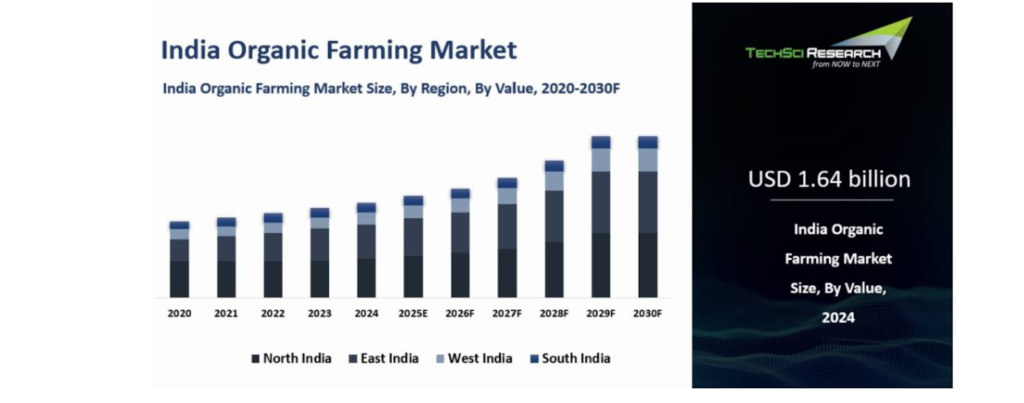
Starting an Organic Farming Business in India signifies great prospects. Along with the government support, the export potential, and the increasing customer preference for chemical-free products, organic farming could be a practical business. The research has indicated that the organic farming market of India will increase from $1.64 billion in 2024 to approximately $2.13 billion by 2030. India had almost 2.3 million hectares of land practicing organic farming as of March 2019.
Why Choose an Organic Farming Business in India?
Organic farming in India is gaining popularity due to growing health awareness, better market prices, and strong government support for sustainable agricultural practices.
- Premium pricing: Certified organic products generally get higher prices than conventional crops, since the decreased chemical usage and consumer willingness to pay lead to this situation.
- Government support: One of the government’s major support schemes related to organic farming, certification, and marketing is the Paramparagat Krishi Vikas Yojana (PKVY), under which farmers receive financial assistance for organic input purchases, group certification, and marketing support.
- Growing market: Urban customers in India are becoming increasingly conscious about health issues, pesticide residues, soil fertility, and sustainability—leading to a steady rise in the demand for organic products. According to APEDA, the Indian organic food market has been growing at over 20% annually, driven largely by urban consumption trends.
Pre-Setup Checklist
Before starting an organic farming business in India, farmers must evaluate land, soil quality, crop suitability, and certification requirements
- Land and Soil suitability: Have the soil tested for various factors, including pH, nutrients, and organic matter, so that it can be confirmed that the land can grow organic crops.
- Picking and agro-climate fitting: Spices, cereals, millets, pulses, vegetables, fruits, and organic certification possibility are options depending on crops suited to your region.
- Certification comprehension: Be familiar with the ruling of organic certification (e.g., the national programme National Programme for Organic Production for exports).
Setup Process & Timeline
Setting up an Organic Farming Business in India can be done more simply with this guide:
- Land and Soil Preparation: For soil health, using such methods as compost, green manure, and biofertilizers is a must. It might take considerable time to carry out this practice, but the soil’s fertility will be boosted a lot over the long run as a result of it
- Seed Selection and Earth Preparation: Choose the organic or non-hybrid seeds. Besides, if necessary, install irrigation (drip being the most suitable), build fences, and create a small spot for storage or shade that is small.
- Organic Farming Input Systems: Construct the compost pits or vermicompost units and acquire the bio-pesticides and natural fertilizers.
- Planting and documentation: The planting will be carried out by using organic methods that no synthetic chemicals will be used. Crop rotation and intercropping will be carried out.
- Certification and marketing: Submit the application to an accredited certifying body, schedule the inspections, and adhere to all the organic rules.
Cost Estimates for First Year
In India, the costs associated with the initial year of a 1-hectare setup can be very roughly estimated at the following ranges, mainly depending on the particular state/crop:
- Land preparation & planting: ₹30,000 – ₹70,000.
- Seeds/planting material & organic inputs: ₹40,000 – ₹90,000.
- Labour & maintenance: ₹50,000 – ₹1,00,000.
- Irrigation/infrastructure: ₹10,000 – ₹50,000.
- Certification cost: ₹3,000 – ₹15,000 (often subsidised).
Estimated total cost: ~₹1,30,000 to ₹3,30,000
Loan & Subsidy Options
Various government schemes and financial institutions in India offer loans and subsidies to support organic farming setup, certification, infrastructure development, and sustainable agricultural practices.
- PKVY: Scheme promoting cluster-based organic farming provides financial assistance per hectare, training, and certification support.
- NABARD (National Bank for Agriculture and Rural Development): Through banks or financial institutions, it provides refinancing, subsidy, and lending for the organic farming/processing projects to the extent of 100% of the project cost.
- MUDRA / Agri-signing loans: The PMMY (Pradhan Mantri MUDRA Yojana) scheme provides the facility of applying for loans for small processing units, farm equipment, and input units.
Profit Potential & What to Plan
Organic farming offers higher long-term profit potential than conventional farming, though initial yields may be lower.
- The profit margin in organic farming may be higher than that of conventional farming, but the process of achieving it is typically longer.
- The studies led to the conclusion that organic farming would yield less initially, possibly even with the total output being up to 25% lower than that of non-organic at the very start of the transition due to limited synthetic input use.
- The profit is greatly affected by: selection of crops, price for organic, yield, and management of costs.
Marketing & Sales Strategy
- Prepare a list of potential buyers that will consist of organic shops, nearby markets, and direct-to-consumer strategies.
- Join in organic fairs and farmers’ markets to promote your brand.
- Employ digital marketing alongside online marketplaces (BigBasket, Amazon Karigar, etc.) for the sale of organic produce.
- Increase brand trustworthiness by providing food traceability along with clear and easily accessible certification records.
Conclusion
India is an organic farming business startup that’s a realistic and promising opportunity. The costs during the first year are not that high (e.g., ₹1.3 – 3.3 lakhs), and the government is also offering subsidies and loans. The individual will have to do a lot of careful planning, cost management, and relationship building with buyers. An organic farm is a profitable and sustainable enterprise by the 3rd-4th year.
DISCLAIMER: The information given in this blog is for educational purposes only. Any content of this blog is not investment advice.