


Think of Paddle and Pickleball — both are racquet sports, both look similar at first glance, but the rules and strategies are quite different. Flexi Cap and Multi Cap funds operate in a similar manner. Both invest across market caps, both belong to the diversified equity category — yet the mechanics underneath are not the same. Before you pick one for your portfolio, it is worth understanding exactly what sets them apart.
Understanding Market Capitalisation First
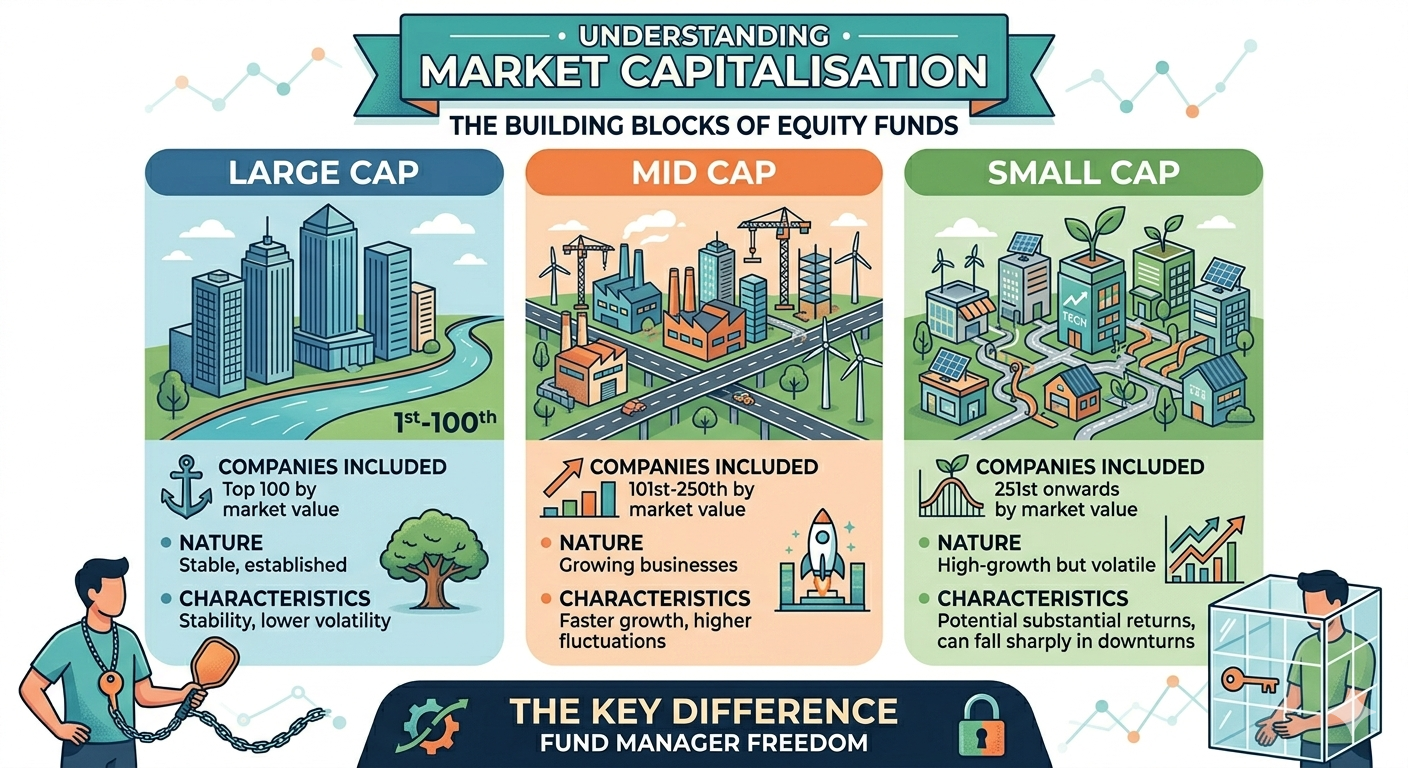
Before comparing these funds, it helps to understand the three market-cap categories they invest in.
| Category | Companies Included | Nature |
| Large Cap | Top 100 companies by market value | Stable, established |
| Mid Cap | 101st–250th companies | Growing businesses |
| Small Cap | 251st onwards | High-growth but volatile |
Large-cap stocks generally offer stability and relatively lower volatility. Mid-cap companies can grow faster but come with higher fluctuations. Small-cap stocks have the potential to generate substantial returns over long periods, but they can also fall sharply during market downturns.
The real difference between flexi-cap and multi-cap funds lies in how much freedom the fund manager gets while investing across these segments.
What is a Flexi Cap Fund?
A flexi-cap fund is an open-ended equity scheme that invests across large-cap, mid-cap, and small-cap stocks, with no fixed allocation requirement for any particular categorisation. SEBI mandates a minimum of 65% in equity, but the split between large, mid, and small-cap is entirely the fund manager’s call.
This is the defining feature. The fund manager has the freedom to move money wherever the opportunity looks strongest. In a volatile market, they may park a huge percentage in large-caps for stability. During a bull run, they may tilt aggressively toward mid-caps to capture upside.
Key structural facts about Flexi Cap funds include:
- Minimum 65% allocation in equity and equity-related instruments.
- No mandatory allocation across market cap segments.
- The fund manager has full discretion over portfolio construction.
- Risk level depends heavily on the current allocation style.
For example, HDFC Flexi Cap Fund, one of the largest in this category, has held a dominant large cap tilt — roughly 70-75% in large caps — with selective mid and small cap bets. It suits investors who want equity exposure but with a relatively steadier hand guiding the portfolio.
What is a Multi Cap Fund?
Multi Cap funds also invest across all three market cap segments, but here, SEBI has set a strict minimum allocation rule. As per SEBI’s rules, every multi-cap fund must maintain at least:
- 25% in large-cap stocks
- 25% in mid-cap stocks
- 25% in small-cap stocks
The remaining 25% can go anywhere across segments. Total equity allocation must stay at a minimum of 75%.
This mandatory diversification is both its strength and its source of risk. Regardless of market conditions, the fund must hold significant mid and small cap exposure, which means during downturns, the portfolio cannot entirely retreat to the safety of large caps.
Key structural facts about Multi Cap funds include:
- Minimum 75% in equity
- Compulsory 25-25-25 split across large, mid, and small-cap stocks
- Remaining 25% at the fund manager’s discretion
- Higher inherent volatility compared to large cap-heavy portfolios
Consider Nippon India Multi Cap Fund, which has consistently maintained its mandatory allocation but has used the flexible 25% to rotate between sectors based on macro conditions — infrastructure, capital goods, banking — reflecting active management within a constrained structure.
Understanding Their Similarities
Despite their differences in structure, flexi Cap and multi Cap funds share a common investment philosophy: broad equity diversification across market capitalisations.
| Parameter | Flexi Cap | Multi Cap |
| Investment Universe | Large, Mid, Small Cap | Large, Mid, Small Cap |
| SEBI Category | Diversified Equity | Diversified Equity |
| Minimum Equity | 65% | 75% |
| Suitable For | Long-term wealth creation | Long-term wealth creation |
| Tax Treatment | Same (LTCG at 12.5% above ₹1.25 lakh) | Same |
| Fund Type | Open-ended | Open-ended |
Both categories are subject to the same tax rules — short-term capital gains at 20% and long-term capital gains at 12.5% beyond the ₹1.25 lakh exemption limit. Both are suited for a minimum investment horizon of 5-7 years and are appropriate vehicles for SIP-based investing.
Core Differences: Where They Actually Diverge?
This is where investors need to pay careful attention. The structural difference in allocation rules creates a meaningful difference in how these funds behave.
- Allocation Flexibility
In a Flexi Cap fund, the manager can hold 90% in large caps tomorrow if macro signals turn cautious. In a Multi Cap fund, that is not possible — a minimum of 25% will always sit in mid caps and another 25% in small caps, regardless of the market environment.
- Risk During Downturns
Mid-cap and small-cap stocks typically fall harder and faster in a market correction. A multi-cap fund, by regulation, cannot reduce this exposure below 25% each. A flexi cap fund can. This makes multi-cap funds structurally more volatile during bear markets.
- Return Potential
When mid and small cap segments are rallying, multi-cap funds tend to outperform flexi cap funds because of their mandatory mid and small cap exposure. They ride the upswing harder.
- Manager Dependency
Flexi-cap performance is heavily dependent on the quality of the fund manager’s allocation calls. A poor call — for instance, sitting in large caps while mid caps rally — can significantly drag returns. Multi-cap funds are somewhat insulated from this because the structure forces diversification.
| Parameter | Flexi Cap | Multi Cap |
| Large Cap Minimum | No mandate | 25% minimum |
| Mid Cap Minimum | No mandate | 25% minimum |
| Small Cap Minimum | No mandate | 25% minimum |
| Manager Discretion | Very high | Moderate |
| Downside Protection | Better (can shift to large cap in times of distress) | Limited |
| Upside in Bull Run | Depends on manager calls | Structurally captures mid/small cap rally |
| Volatility | Lower to moderate | Moderate to high |
Risks Involved in Each
Flexi Cap — Risks to Watch
The biggest risk in a flexi cap fund is concentration. If the manager builds a heavy large cap portfolio to stay cautious, the fund may underperform its benchmark when mid and small cap stocks are running. Conversely, an aggressive tilt toward small caps during a downturn can cause significant reduction in its value.
There is also style drift; a fund that was positioned as balanced may start behaving like a large-cap fund or a mid-cap fund, depending on the manager’s convictions. Investors who entered with a certain risk expectation may find their portfolio behaving differently over time.
Multi Cap — Risks to Watch
The mandatory 25% small-cap allocation is a structural risk. Small-cap stocks are illiquid, prone to sharp corrections, and can remain depressed for extended periods. During market downturns like COVID, small-cap funds fell 40-50% from their peaks. A multi-cap fund carries this risk without the option to exit.
There is also sector concentration risk — fund managers sometimes cluster the discretionary 25% in a single high-conviction sector, which amplifies volatility.
Which One Should You Choose?
The confusion between choosing a flexi-cap vs a multi-cap fund exists. Thus, the right pick depends on where you are in your investment journey and how much volatility you can stomach without hitting the redeem button.
The table below breaks it down plainly:
| Your Situation | Better Fit |
| New to equity mutual funds | Flexi Cap |
| Want all-in-one market cap diversification | Multi Cap |
| Already hold mid cap / small cap funds | Flexi Cap |
| Higher risk appetite, 7+ year horizon | Multi Cap |
| Prefer manager-driven, tactical allocation | Flexi Cap |
| Want structure, not dependent on manager calls | Multi Cap |
| Conservative accumulation phase | Flexi Cap |
| Comfortable riding short-term volatility | Multi Cap |
A simple way to think about it: if you have ₹10,000/month to start investing and want one fund that does everything — large, mid, and small cap — Multi cap is the cleaner choice. You get mandatory diversification built into the product itself. No extra funds needed.
On the other hand, if you already run a mid-cap or small-cap SIP, adding a multi-cap fund means you are doubling down on the volatile end of the market. A flexi-cap fund slots in better there by giving you equity exposure without stacking risk.
On returns, neither category has a clear edge over the long run. Top-performing funds in both have delivered on average, a 14–16% CAGR over a 10-year period. The real difference is not in the final number — it is in how the ride feels along the way. Multi-cap funds tend to be bumpier; flexi-cap funds can be steadier, though that depends heavily on the manager.
Thus, you should pick the right one based on your portfolio gaps, not just past return charts.

Conclusion
Flexi Cap and Multi Cap funds are not competitors — they serve slightly different investor needs. If flexibility and manager discretion appeal to you, flexi cap fits. If you want structured, non-negotiable diversification across company sizes, a multi cap delivers that. In both cases, consistent SIP investing over the long-term (7-10 years+), backed by patience, tends to do more for wealth creation than any fund selection debate ever will.
Frequently Asked Questions
| 1. Can a fund manager of a Flexi Cap fund invest 100% in large cap stocks? |
| Technically, yes — as long as the minimum 65% equity requirement is met, the manager can concentrate entirely in large cap stocks. However, most funds maintain a diversified approach to justify the Flexi Cap mandate. Investors should regularly review the portfolio fact sheet to check actual allocation patterns. |
| 2. Which fund is safer — Flexi Cap or Multi Cap? |
| Flexi Cap funds are generally considered less volatile because the fund manager can shift heavily toward large cap stocks during uncertain markets. Multi Cap funds must maintain at least 25% each in mid and small cap stocks at all times, which means they carry more risk during downturns. That said, “safer” is relative — both are equity funds and carry market risk. |
| 3. Which fund is better for a first-time SIP investor? |
| For someone just starting out, a flexi-cap fund is usually the more comfortable entry point. Most flexi-cap funds naturally tilt toward large caps, which means lower volatility and a less jarring experience during market corrections. Once you are familiar with how equity markets move, you can consider adding a Multi Cap fund for broader diversification. |