

The first significant choice made by every Indian investor is selecting a stockbroker. With dozens of apps vying for users’ attention, the debate surrounding Zerodha vs Groww vs Upstox is unlikely to go away in 2026. Despite serving somewhat distinct types of investors, these three platforms collectively account for a sizable portion of all active demat accounts in the nation today.
Whether you’re a beginner, a long-term investor, or an aggressive trader, this guide explains how each platform functions, where it excels, and where it fails. This guide helps you compare Groww, Zerodha, and Upstox according to your personal investment style.
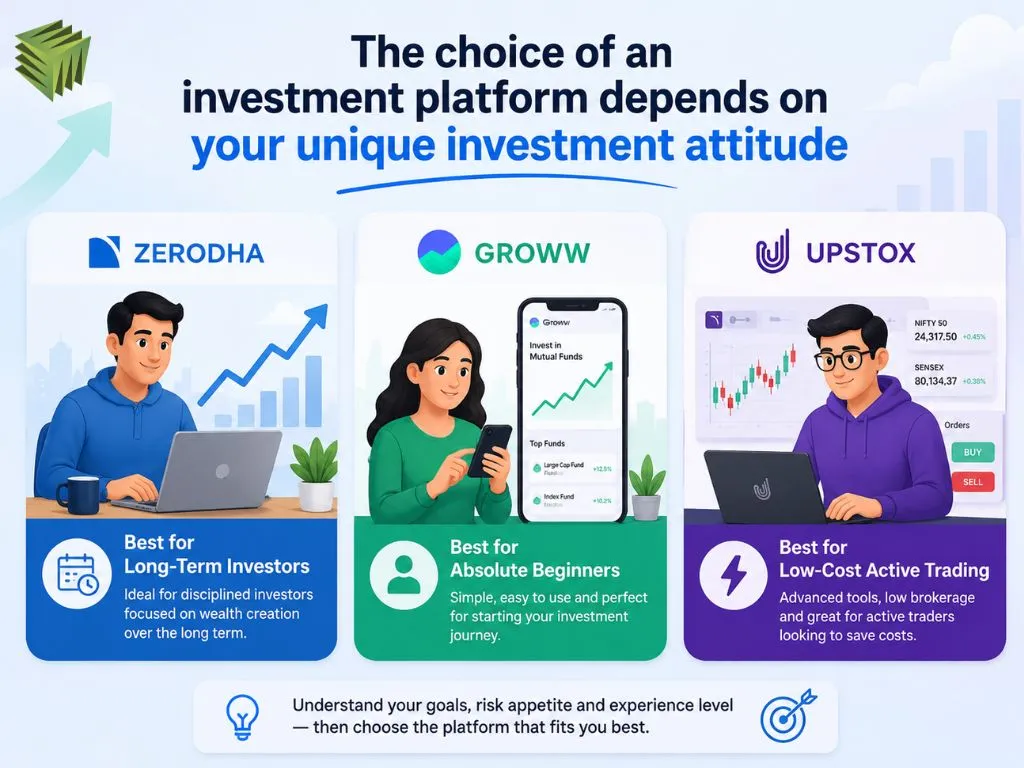
Zerodha: Best for Long-Term Investors
Zerodha was founded in 2010 by brothers Nithin and Nikhil Kamath. This platform basically established discount broking in India. Before Zerodha, most brokers charged a percentage of transaction value; Zerodha pioneered flat-fee and zero-brokerage pricing, and the rest of the industry, including Groww and Upstox, ultimately followed suit. Despite falling to second place by active customer count behind Groww, Bengaluru-based Zerodha is still by far the most prominent brokerage in India.
A large number of traders and investors utilise Zerodha’s primary platform, Kite. The business has created a real ecosystem around it, including Varsity for free stock market education, Coin for direct mutual fund investment, and Console for portfolio management and tax reports. It also has several integrations like Sensibull (options strategy tools) and Streak (algo trading).
Strengths
- Brokerage on Equity Delivery: Zero brokerage is levied on equity. Only statutory fees, like STT and GST, apply.
- Intraday and F&O Trading: Intraday transactions are among the least expensive in the market, with fees of 0.03% or ₹20 per order, whichever is lower.
- Free Ecosystem: Unlike its competitors, Zerodha has created an entire ecosystem. It not only targets different investment avenues but also aids investor education.
- Reliability and Transparency: Serious investors have developed a strong sense of confidence due to the company’s decades-long operation and continuously clear pricing.
- NRI Trading Support: Zerodha offers NRI trading accounts, which are beneficial for the Indian diaspora.
Limits
- No Personalised Research or Advice: Since Zerodha is purely a broker, beginners often have to conduct their own independent research. Although Varsity aids investor education, it is still self-directed.
- Functional but Not Flashy UI: Some amateurs find Groww’s streamlined interface more straightforward than Kite. Zerodha seems to place more emphasis on function than form.
- Annual Maintenance Charges (AMC): Zerodha has different AMCs for different investor categories. Holdings up to ₹4 lakhs have zero AMC levy, while holdings from ₹4-10 lakhs require ₹100 plus 18% GST. Holdings above ₹10 lakhs require ₹300 and 18% GST. All these fees are charged quarterly.
- Occasional Load Issues: Users have observed brief slowdowns on Kite on days with exceptionally high volatility or expiration.
Who is Zerodha Best For and Why
Long-term investors and independent traders who are at ease with doing their own research before making an investment and who want the best prices together with a sophisticated, feature-rich environment will find Zerodha appealing. Zerodha’s pricing structure and tools are quite advantageous if you choose to stay invested for years rather than days, track a diversified portfolio with Console, and study up on fundamentals using Varsity.
Groww: Best for Absolute Beginners
Four former Flipkart employees, namely Lalit Keshre, Harsh Jain, Ishan Bansal, and Neeraj Singh, established Groww in 2016. Their straightforward objective was to make direct mutual fund investing as simple as online shopping. Since then, it has grown to include stocks, bonds, IPOs, F&O, ETFs, and even digital gold. All of these are housed within the same app. The interface is user-friendly, making it suitable for beginners and experienced investors alike. Groww went public in November 2025. It surpassed Zerodha in 2023 to become the largest broker in the nation by the number of active NSE clients.
First-time investors, including students, young professionals, and small-town users, form the key target group of Groww. A simple, distraction-free interface, along with its zero-AMC, zero-account-opening-fee concept, eliminated a lot of the friction that previously discouraged investors from investing.
Strengths
- Beginner-Friendly Interface: Often regarded as the most user-friendly program for someone setting up their first demat account.
- Zero AMC and Account Opening Fees: Unlike many platforms, there is no annual maintenance cost and free account opening.
- Unified Investing Experience: Without switching platforms, mutual funds, ETFs, and digital gold are all housed in a single app.
- Strong Brand Trust and Scale: Groww has clear market credibility as the biggest broker by active clients and as a publicly traded firm.
- Quick Onboarding: Most consumers may start trading within a day with fully digital Know Your Customer (KYC).
Limits
- Fewer Complex Trading Features: Although the 915 Terminal caters to more active traders, the simplicity of the original Groww interface can be at the expense of depth. Complex charting, algo trading, and research features are somewhat restricted when compared to Zerodha.
- Delivery Isn’t Completely Free: Groww costs ₹20 or 0.1%, whichever is lower, for equity delivery transactions.
- Less Depth for Serious Traders: Investors may outgrow the software if they eventually want sophisticated order types or in-depth technical analysis.
- Newer to Public Markets: Due to its recent listing, the company’s governance and long-term public-market success are still in the process of establishment.
Who is Groww Best For and Why
For absolute beginners, Groww becomes a natural choice. It is suitable for those opening their first demat account or mutual fund SIP and want zero friction. It offers zero AMC and a single, user-friendly interface for stocks, MF, and IPOs. Groww eliminates almost all entrance barriers. It is suitable if you’re not trading intraday or F&O and just want to start investing without complication.
Upstox: Best for Low-Cost Active Trading
Ravi Kumar, Raghu and Shrinivas Viswanath launched Upstox in 2011 as RKSV Securities. With support from prominent investors including Ratan Tata and Tiger Global, the company eventually changed its name. Its Pro Web and Pro Mobile platforms, which are powered by TradingView charting, have long been well-liked by active traders who demand complex charts without paying full-service brokerage. The company built its name on tech-first, low-cost trading.
Upstox is still one of the top players in terms of active clients, but like several conventional discount brokers, it has suffered a decline in clientele in FY26 due to a downturn in the market. For traders who value charting capability and automation above simplicity, Upstox become a natural choice. Its flat ₹20 per order cost across delivery, intraday, and F&O, together with API access for algorithmic trading, keeps it relevant.
Strengths
- Advanced Charting with TradingView: Upstox Pro incorporates TradingView, providing traders with comprehensive technical analysis capabilities that are rarely available for free elsewhere.
- Fixed, Predictable Pricing: Frequent traders may easily calculate costs because the charge is fixed at ₹20 per order for delivery, intraday, and F&O.
- API and Algo Trading Access: Traders creating automated strategies are drawn to Upstox’s developer console and API support.
- Supported by Reliable Investors: Credibility and financial stability are provided by affiliation with Ratan Tata and Tiger Global.
- Multi-Segment Trading: Enables trading of commodities, stocks, F&O, and currencies in a single account.
Limits
- Declining Active Customer Base: Upstox’s active customer numbers are declining in comparison to Groww and Zerodha, according to recent industry data.
- AMC and Account Charges: Although zero AMC is levied for new customers in the first year, apart from Basic Services Demat Account (BSDA) users, everyone has to pay ₹300.
- Customer Service Consistency: On days when the market is busy, some customers complain about delayed response times.
- Less Beginner-Oriented Than Groww: Although the more sophisticated charting and tools are useful for traders, they may seem excessive to a beginner.
Who is Upstox Best For
Active and intraday traders as well as F&O players that need sophisticated charting and API-driven automation at affordable, consistent flat-fee pricing may find Upstox appealing. Upstox is still a great option if you value algorithmic trading help and in-depth technical analysis more than beginner ease of use or the cheapest delivery price.
Zerodha vs Groww vs Upstox
Here’s a side-by-side comparison of Groww, Zerodha, and Upstox.
| Parameters | Zerodha | Groww | Upstox |
| Rank based on active clients | Second | First | Among the top |
| Equity delivery charge | ₹20 or 0.03%, whichever is lower | ₹20 or 0.1%, whichever is lower | ₹20 flat |
| AMC | Up to ₹300/year | Free | Up to ₹300/year |
| Unique selling point | Advanced trading and autonomous investing | Beginner-friendly interface and easy to navigate | Technical and sophisticated charts that aid advanced traders |
Bottomline
There is not a single brokerage platform that fits all. The suitability among Zerodha vs Groww vs Upstox depends on your investment strategy and attitude. For long-term, budget-conscious investors who prefer a developed environment and don’t mind a somewhat higher learning curve, Zerodha continues to be the best option. Beginners often choose Groww, while technical and sophisticated traders can lean towards Upstox. Other platforms like Angel Broking offer advisory services, along with execution. Therefore, investors can also widen their comparative analysis to Angel Broking vs Zerodha vs Upstox vs Groww.
Highlights
- Zerodha can be suitable for long-term, self-directed investors since it provides zero delivery brokerage and more autonomous decision-making.
- Groww is the biggest broker in India based on active clients and the easiest software for beginners to start investing.
- Upstox attracts active and F&O traders with its TradingView graphing and consistent ₹20-per-order price across all segments.
FAQ
Between Zerodha and Groww, which is better for beginners?
Groww is often easier for beginners because of its simplified interface, zero AMC, and integrated mutual fund and stock investing expertise. Zerodha is ideal for newcomers who are prepared to invest some time learning the platform in exchange for cheaper long-term fees and free educational tools, such as Varsity.
Is Upstox good for F&O trading?
Yes. Upstox’s flat ₹20-per-order price, TradingView-powered charting, and API access for algorithmic methods make it a viable alternative for active F&O and intraday traders. Such investors usually seek technical depth and cheap, predictable expenses.
Can I switch brokers without losing my portfolio?
Yes. You can avoid selling your shares by transferring your current holdings to a new demat account via off-market transfer. Many investors simply create a second account and keep both active.