


India’s relationship with money management has changed fast. Smartphone penetration has crossed 750 million users, UPI turned every phone into a bank branch, and a wave of fintech apps now do what financial planners once charged for: tracking expenses, monitoring investments, and nudging better money habits. Millions of Indians, especially millennials and Gen Z, now prefer opening an app over booking an advisor’s appointment.
This shift is about automation, not full replacement. Personal finance apps in India now handle the repetitive, data-heavy parts of planning: portfolio aggregation, SIP tracking, expense categorisation, credit monitoring, so users can act without paying advisory fees. But apps can’t cover every dimension of professional advice; estate planning and complex tax structuring still benefit from a human expert. What they do very well is automate the everyday financial planning and monotonous tasks. Here are the best personal finance apps in India.
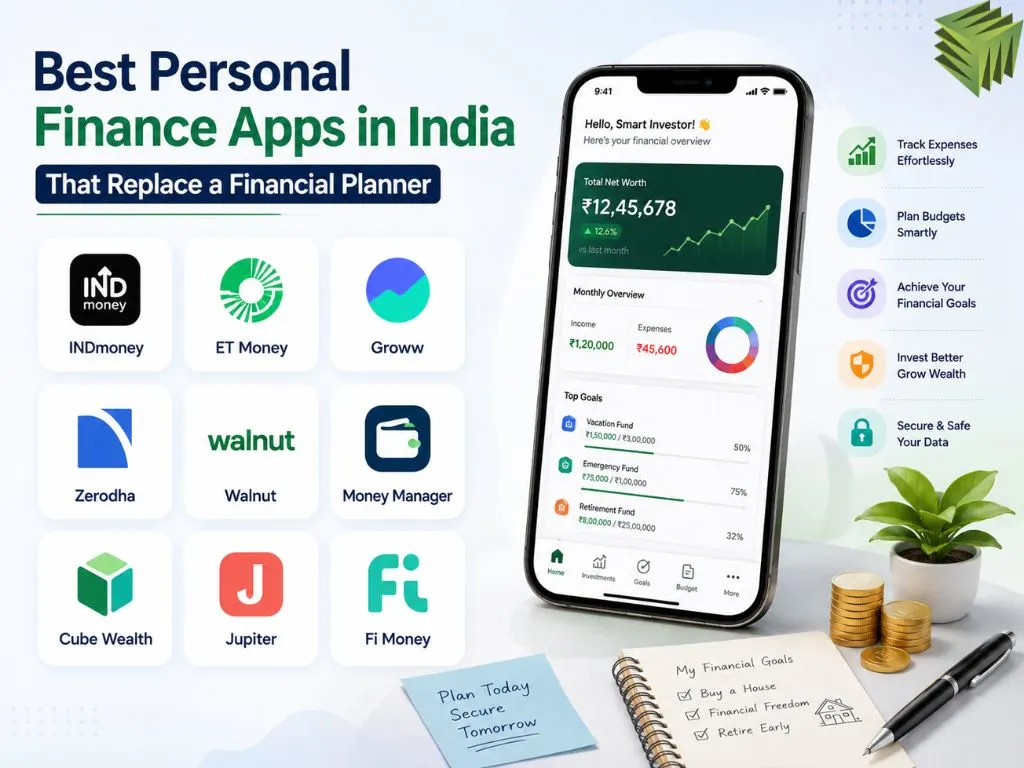
1. INDmoney
INDmoney is a personal finance app in India that aggregates stocks, mutual funds, EPF, NPS, bank accounts, and US equities into one net-worth dashboard. Founded by Ashish Kashyap (ibibo/goibibo founder), it has crossed 10 million users on the Play Store. It’s SEBI-registered as a stockbroker and CDSL depository participant.
One login shows your complete net worth; direct mutual funds, IPOs, and goal-based SIPs are free. However, fund recommendations are algorithm-driven, not SEBI RIA advice, and the paid tier is needed for human-hybrid support; free-tier support can be slow.
2. ET Money
Now part of the 360 ONE Wealth group, ET Money is trusted by over one crore (10 million) investors and regulated by SEBI, RBI, PFRDA, and IRDAI. It focuses on mutual funds, insurance, FDs, and NPS rather than stock trading.
Its Portfolio Health Check scores your holdings on 100+ parameters and suggests fund replacements, close to an advisor’s quarterly review. However, it is narrower than INDmoney or Groww since it skips stock trading, and some users report sync glitches with externally held MF folios.
3. Groww
Groww is India’s largest stockbroker, with over 2 crore active users across 98.36% of India’s pincodes. 81% of its users reside outside of metropolitan areas, while about 45% of users are under 30. This top finance app in India is an investment platform that allows investors to invest and manage their portfolios.
For first-time investors, this software offers free direct mutual funds and flat brokerage for equities, mutual funds, US stocks, ETFs, IPOs, F&O, and digital gold. The website is easy to navigate. However, F&O trading still accounts for a sizable portion of Groww’s income, and the company purposefully omits advisory information, resulting in customers conducting independent research.
4. Zerodha
One of the top finance apps in India and the second-largest platform by active clients, Zerodha pioneered discount broking in India under founders Nithin and Nikhil Kamath.
It has developed different platforms, each targeting a specific need. Zerodha houses Kite for trading, Console for consolidated portfolio and tax reports, and Coin for direct mutual funds. Varsity, also a Zerodha offering, is one of India’s most respected free investor-education resources. However, it is designed for self-directed investors, with no guidance or budgeting layer. The customer support or assistance of the platform may lag during high-volume periods.
5. Walnut
Walnut, one of India’s earliest SMS-based expense trackers, is now rebranded as Axio, after merging with Capital Float and Walnut369. It still auto-reads transactional SMS from banks to build expense summaries, but now also offers Pay Later credit, personal loans, and FDs through its NBFC arm.
It offers genuine automation, no manual entry, plus bill reminders and category-wise spend visibility. However, its identity has shifted toward credit distribution. The redesigned interface draws complaints, and it requires SMS-read permissions that privacy-conscious users should weigh.
6. Money Manager
Money Manager (by Realbyte) is a manual, double-entry expense and budget tracker for users who’d rather not link bank accounts at all. It supports budget-versus-actual graphs and multi-currency tracking, useful for NRI income.
It has no SMS or bank account access requirement. The free edition does not have automated bank sync, investment tracking, or India-specific GST or ITR functions. Hence, it is best used in conjunction with a separate investing software.
7. Cube Wealth
Cube Wealth comes closest to replicating an actual financial planner. Its curated recommendations lean on SEBI-registered RIAs including WealthFirst and Purnartha. Every user gets a dedicated Wealth Coach on WhatsApp, and the company reports high user retention.
It offers real human guidance plus access to alternative assets like P2P lending, asset leasing, and US equities most retail apps skip. However, it is built for busy professionals with investable surplus, not tight-budget beginners, and it runs a distribution-based revenue model worth understanding.
8. Jupiter
Jupiter is a neobank founded in 2019 by Jitendra Gupta (ex-Citrus Pay), operating through partner bank Federal Bank since it holds no banking licence itself. This personal app has raised over $160 million and reported close to a million users within ten months of launch.
The platform offers “Spend Insights”, which auto-categorises transactions, goal-based auto-saving with UPI cashback, and zero-balance accounts to remove a common banking barrier. However, it is not a full investment platform and offers mainly banking plus spend tracking. The sector has seen reported profitability pressure and layoffs.
9. Fi Money
Founded by Sujith Narayanan and Sumit Gwalani, both ex-Google Pay India, Fi Money also runs on a Federal Bank partnership. It offers savings accounts, an auto-categorising “Analyser” dashboard, savings jars, and access to mutual funds and US stocks via partners.
It is a polished, analytics-first interface for banking plus light investing in one app. However, it relies on its partner bank for fundamental infrastructure and an investing platform.
Which Financial Planning Tasks Can These Apps Replace?
The best personal finance apps in India can help automate monotonous tasks and level up financial planning.
- Budgeting and Expense Tracking: Axio and Money Manager automate what used to be a spreadsheet exercise, via SMS reading or structured manual entry.
- Investment Planning: Groww, Zerodha, and ET Money handle fund selection, SIP execution, and rebalancing prompts through portfolio health scores and fund-replacement suggestions.
- Net Worth Tracking: INDmoney and Cube Wealth replace the annual net-worth statement a planner once compiled, updating it in real time instead.
- Goal-Based Investing: Finance apps help individuals set their savings and investments based on their goals, whether long-term or short-term.
Features to Look For Before Choosing a Personal Finance App
Before settling for one of the top finance apps in India, here are some features you must look for:
- Automatic Bank Sync: Maintains expense data without manual intervention.
- Investment tracking: It should combine equities, mutual funds, EPF, and NPS into a single platform.
- Goal Planning: Long-term plans are kept tangible by systematic goal-setting and observable progress.
- Expense Categorisation: Useful insights are produced by accurate, automated categorisation.
- Tax Reports: Platforms that can offer features for filing season, capital gains statements and P&L reports save time.
- Security Standards: Check for SEBI or RBI registration and be aware of the precise permissions (bank-linking, SMS) that the app asks for.
Benefits of Using Personal Finance Apps
Using a personal finance app in India can offer the following benefits:
- Reduced Cost: The majority of apps are either free or need a small yearly membership, which is far less than what fee-based planners charge for regular reviews.
- Real-Time Financial Insights: The quarterly or annual review cycle of conventional advisory services is replaced with instant portfolio updates.
- Automation: Bill reminders, SIP monitoring, and expense tracking automate manual work. It eliminates the need for manual maintenance.
- Anytime Access: Due to the mobile-first design, the user can keep track of their finances from any location, not just during business hours.
- Easier Financial Discipline: Goal-tracking dashboards, monthly reports, and notifications provide the same type of prompting a planner would during a check-in call.
Bottomline
Most of the features that traditionally needed a planner’s spreadsheet and a scheduled call have been included in free or inexpensive personal finance apps. Goal-based automation, SIP monitoring, portfolio aggregation, and spending categorisation are some key features many apps offer. However, an algorithm cannot completely replace the value that a human planner offers for complex tax planning, high-net-worth estate structuring, or business succession. For most Indians, it makes sense to allow applications like Groww, INDmoney, or ET Money to handle day-to-day tasks and hire a professional only when complexity warrants it.
FAQs
Can a personal finance app really replace a finance planner?
Yes, for standard tasks like net-worth monitoring, SIP tracking, and budgeting, finance apps can help optimise. However, a human planner is still recommended for intricate estate planning or tax structuring.
Are these apps safe for linking to a bank account?
Reputable applications employ consent-based, revocable data sharing and are governed by SEBI, RBI, or account-aggregator frameworks. Check the registration of an app before connecting important accounts.
Do I need to pay to get real value?
The majority of essential functions, such as basic goal setting, direct mutual fund investment, and spending tracking, are usually free. Paid levels include sophisticated tax tools or human advice help.