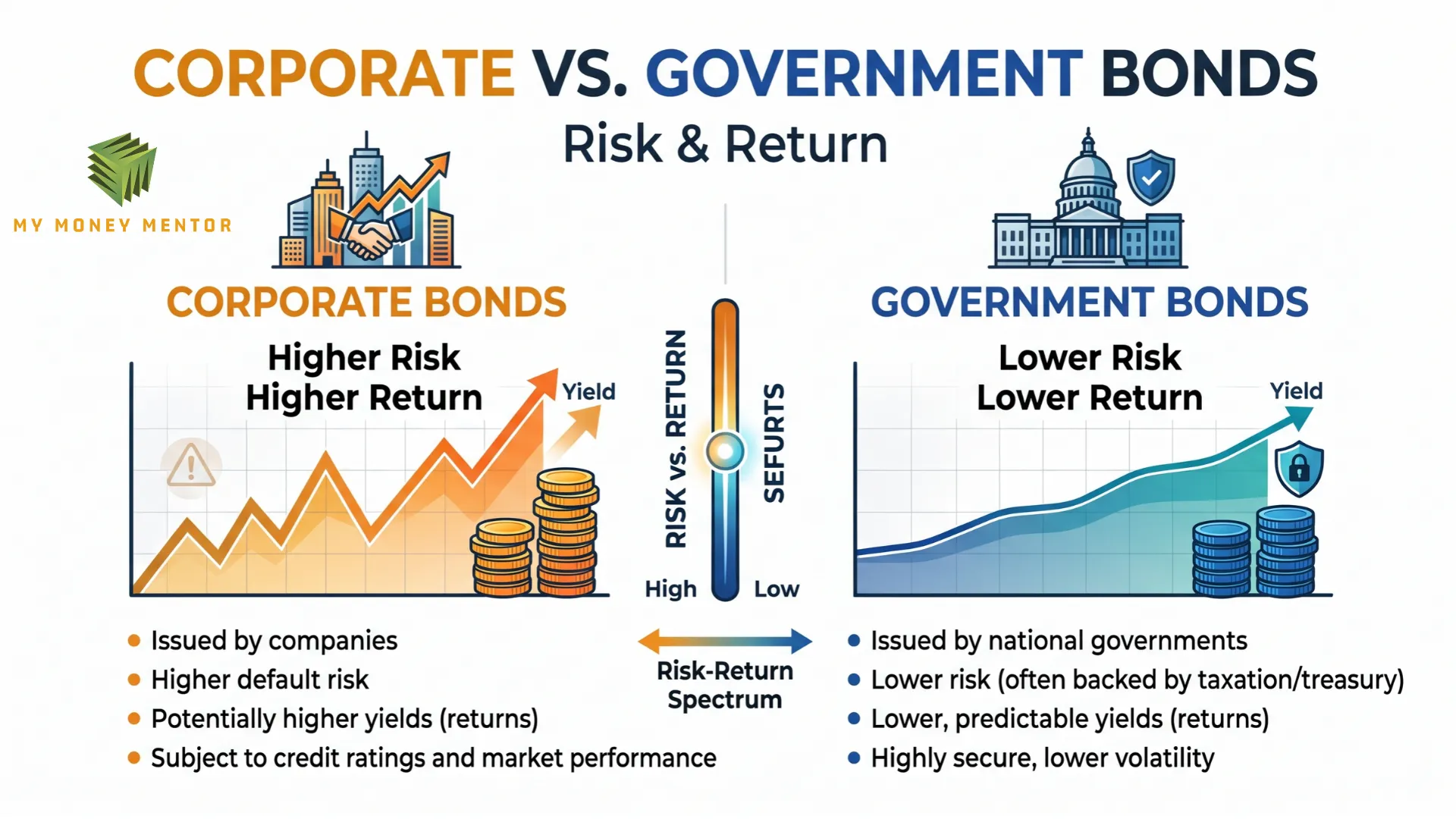

Investors seeking steady income sources always consider corporate vs. government bonds before making an investment decision. Both financial instruments allow one to earn interest and receive the principal back at maturity, but they differ in credit risk, returns, liquidity, and safety. It is important for investors to understand the difference between corporate and government bonds in India.
Governments issue government bonds, whereas companies issue corporate bonds to fund expansion, infrastructure development, refinancing, and other purposes. However, both types can experience depreciation due to changes in interest rates.
Quick Answer:
Government bonds are issued by the Central and State Governments and generally carry lower credit risk. Corporate bonds are issued by companies and may offer higher yields, but involve additional credit and liquidity risks. Both are affected by interest rate changes, so investors should compare yield to maturity, credit ratings, maturity, liquidity and tax treatment before investing.
Key Takeaways
- Government bonds offer minimal credit risk but generally have lower yields, while corporate bonds may offer higher returns to compensate for additional credit and liquidity risks.
- As per the latest benchmark data, 5-year, 10-year and 30-year government bond yields stood at 7.30%, 7.39% and 7.86%, respectively, compared with 7.20%, 7.48% and 7.84% for AAA-rated corporate bonds.
- Both bonds are subject to taxation on interest income at the applicable income tax slab rates. Long-term capital gains are taxed at 12.5%, while short-term capital gains are taxed at the applicable slab rates.
Understanding Basic Fundamentals of Bonds
A bond is a type of borrowing in which the borrower raises money from investors and makes payments of interest and principal according to the terms agreed upon.
A bond can be equated to a loan. In the case of bonds, instead of lending money to the borrower, one buys a financial instrument representing debt.
How Do Bonds Work?
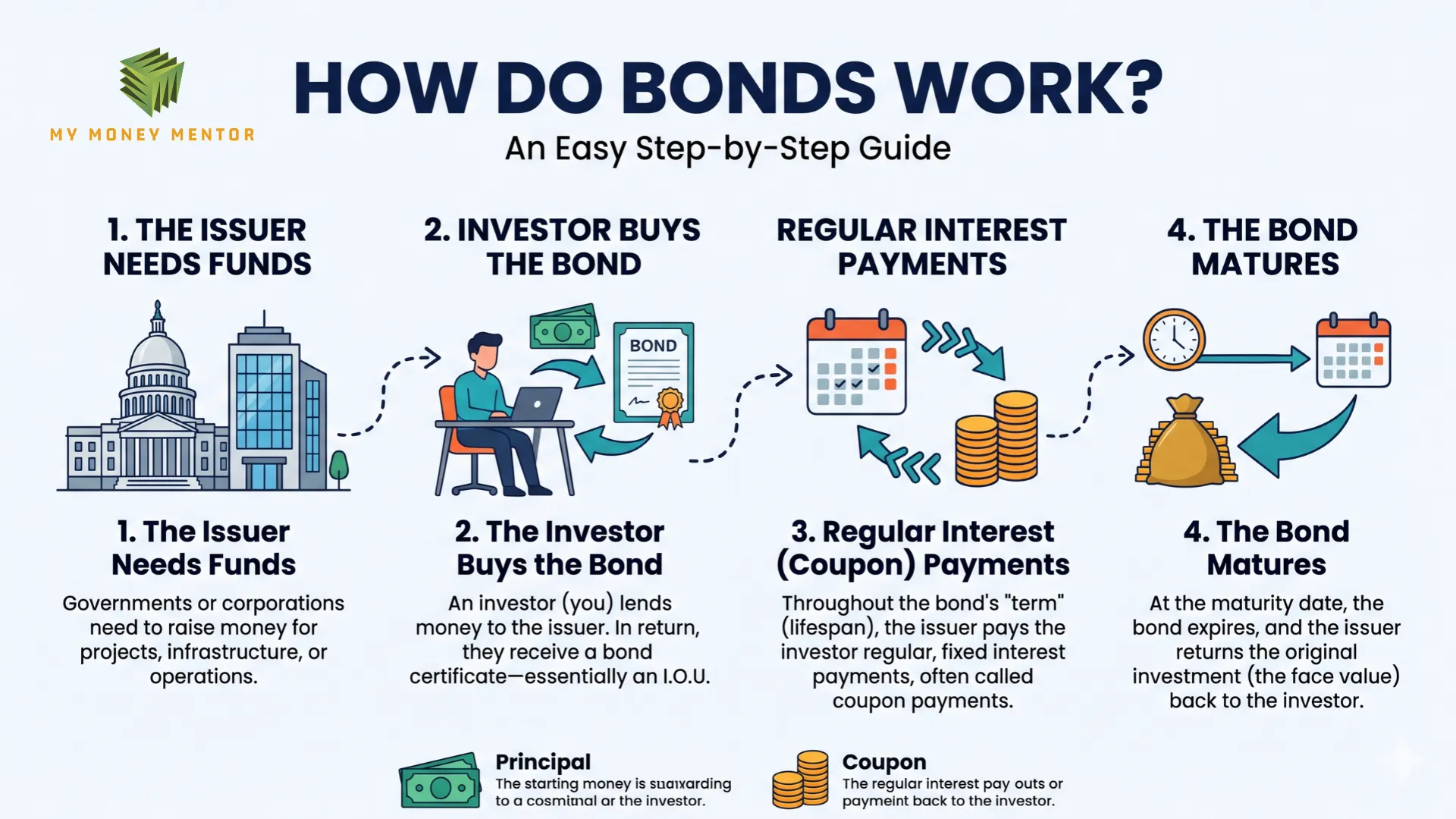
Suppose that one purchases a bond worth ₹10,000 at an interest rate of 7% per annum. If the bond is an annual coupon bond, then one receives ₹700 in interest per year. At maturity, the total principal amount, i.e., ₹10,000, needs to be repaid by the borrower.
Income on the bond is based on the interest, the price paid, and the time held prior to maturity.
The three main ideas that are essential to a new student in this field include:
- Face value: The total value stated on the bond that will be paid at maturity.
- Coupon rate: The rate of interest stated on the bond, expressed as a percentage of the bond’s face value per year.
- Yield to maturity: The estimated annual yield when you buy a bond at its current price and hold it until maturity.
What are Government Bonds?
These are debt instruments issued by the Central or State Governments in order to raise funds for public expenditure. The issuance of government securities is supervised by the Reserve Bank of India (RBI).
Central Government Securities are called G-Secs, whereas State Government Securities are termed as SDLs. Treasury Bills are short-term government securities with maturities of less than one year.
Types of Government Bonds
- Dated G-Secs: Medium- to long-term bonds floated by the Central Government that pay interest regularly.
- Treasury bills: Short-term debt instruments issued at a discount and repaid at face value at maturity, with no interest payments in between.
- State development loans: Government bonds issued by the State Government to raise funds.
- Sovereign gold bonds: Government bonds that earn returns based on the price of gold as per the conditions of issuance. Their return features differ from regular fixed-coupon government bonds.
What Are Corporate Bonds?
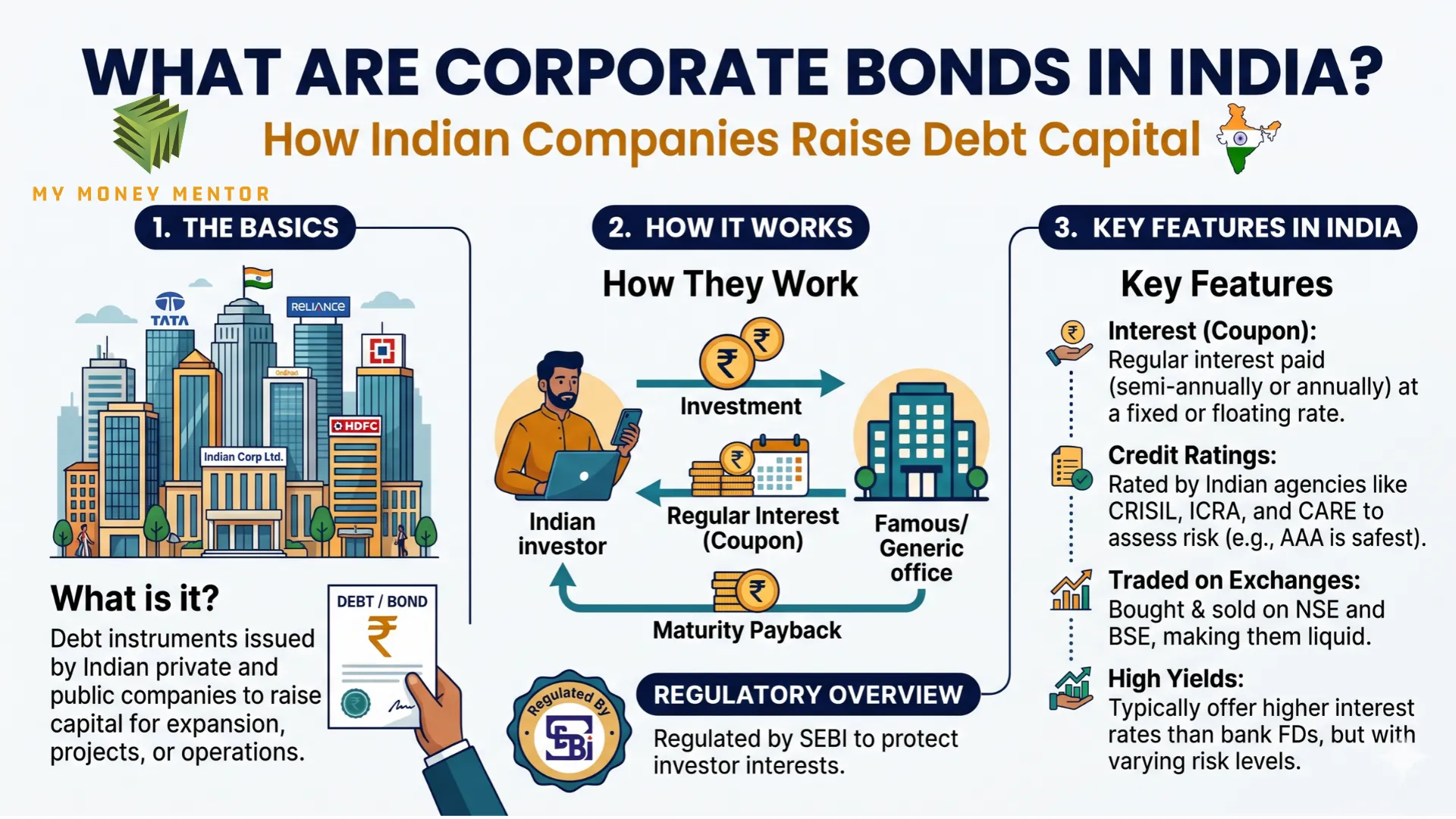
Corporate bonds are debt securities that are issued by private companies, public sector undertakings, and other qualifying corporate bodies. These bonds help raise funds for purposes such as business growth, purchasing equipment or infrastructure development.
By buying a corporate bond, you become a creditor of the company issuing it. This means the company is legally bound to repay the interest and principal on time, as per the terms of the bond; however, the company’s financial position can affect your repayment process.
Types of Corporate Bonds
- High-grade corporate bonds: Bonds of corporations with good credit quality, including those with high credit grades from recognised credit rating agencies.
- Low-grade corporate bonds: These generally carry higher credit risk than other bonds and typically offer higher yields to their holders.
- Secured bonds: Bonds backed by specific collateral under their security provisions.
- Unsecured bonds: Bonds which lack collateral protection.
- Non-convertible debentures (NCDs): Debts which are non-convertible to ordinary shares under any circumstances.
Corporate Bonds Vs Government Bonds
The primary distinction between corporate bonds vs. Government bonds in India is in the identity and financial liability of the issuer. Government securities are those backed by a sovereign guarantee, whereas corporate bonds rely on the ability of the corporation to fulfill its debt obligations.
| Comparison Factor | Government Bonds | Corporate Bonds |
| Issuer | Central or state government | Companies and eligible corporate entities |
| Credit risk | Negligible for Government of India securities in domestic currency | Depends on issuer’s creditworthiness |
| Potential returns | Determined by prevailing yields, maturity and purchase price | May offer higher yields to compensate for additional risks |
| Interest payments | According to the security’s terms | According to the bond’s terms |
| Default risk | Very low for central government rupee securities | Varies by issuer and bond |
| Suitable for | Lower-credit-risk income and portfolio stability | Income diversification, with careful credit selection |
| Taxes | LTCG is taxed at 12.5%, and for short-term at applicable income tax slab rate, and interest income on applicable slab rates, STCG on Tax-free government bonds is 20% | LTCG is taxed at 12.5%, and for short-term at applicable income tax slab rate, and interest income on applicable slab rates |
Corporate Bonds Returns India vs Government Bonds Returns
For the comparison of corporate bonds versus government bonds in India, the best point to start would be with the Yield to Maturity (YTM). The Yield to Maturity (YTM) of a bond is defined as the annualised rate of return that can be achieved based on a bond’s price and cash flows at the moment.
The table below compares government and corporate bond yields across 5-year, 10-year and 30-year maturities, using the latest benchmark data available as of 29, 30 and 23 October 2026, respectively.
| Bond maturity | Government Bonds (G-secs) | Corporate Bonds (AAA benchmark) |
| 5 Years | 7.30% | 7.20% |
| 10 Years | 7.39% | 7.48% |
| 30 Years | 7.86% | 7.84% |
Understanding the Key Risks of Both Bonds
A good comparison between two bonds should be done with an understanding of both the upside and the downside of the investments involved.
Credit/Default Risk:
The risk of credit is the risk of the issuer missing or delaying payment of interest and/or principal. Credit risk is of great importance to corporate bond buyers, since the financial standing of the issuer can change over time.
While Government of India securities in rupee have practically no credit risk in their own currency, corporate bonds can encounter problems such as late payments, restructuring, and default.
Interest Rate Risk:
The price of a bond and its yield tend to move in opposite directions. If market interest rates rise, fixed-interest-rate bonds will lose value, and vice versa. In most cases, longer-term bonds are more responsive to interest rate changes than short-term bonds.
Liquidity Risk:
Liquidity risk occurs when a bond cannot be sold quickly at a reasonable price. For instance, a government security with an active market may be sold more easily than a corporate bond with limited buyers. If an investor requires funds urgently, the bond might be sold at a discount, regardless of the issuer’s financial stability.
Inflation and Reinvestment Risk:
Inflation affects the value of bond interest because when the inflation rate exceeds bond returns, the investor incurs losses.
Reinvestment risk refers to cases in which interest payments or maturing investments must be reinvested at lower rates. The issue can arise when interest rates fall in the market, and no comparable investment yields the same return.
Conclusion
It is necessary to understand corporate vs government bonds in India to invest in securities that align with financial objectives, risk profile, and the desire for a regular stream of income. Usually, bonds issued by the Government of India are relatively safe from a credit perspective, whereas corporate bonds can offer higher returns at the cost of additional credit and liquidity risks.
Both bonds carry market risks, especially when sold before maturity. To make an investment decision, one should consider the yield to maturity, maturity period, creditworthiness, taxation, and liquidity features rather than just the bond that pays the highest interest rate.
FAQs
Q: Is it possible that corporate bonds may make losses despite no default by the company?
Ans: Yes. The price of a corporate bond could fall when interest rates rise, the issuer’s ability to pay diminishes, or its reputation worsens. It means that selling the bond before it matures will result in losses, even though all interest was paid on time.
Q: Is a bond issued by a public-sector company equivalent to a government bond in terms of security?
Ans: No, not necessarily. A public-sector company is an independent borrowing entity, and its bond may not be guaranteed by the government at all.
Q: Should beginners invest directly in individual bonds or through debt mutual funds?
Ans: With individual bonds, one has the flexibility to choose the issuer and maturity; however, such bonds must be evaluated individually for liquidity and ratings. With debt mutual funds, one gets diversity even though there could be variations in their NAVs.