

Summary
- A bond yield is the actual return earned based on the market price of the instrument.
- Bond yield is the return earned while bond price is the market value of the bond
- Bond yield can be categorised as coupon yield, current yield, yield to call, yield to maturity and yield to worst.
Bond yield is the actual return earned by the investor as per the market value or market price of the instrument. It is the margin of the face value and the current market value of the instrument. It indicates how much an investor can earn from a bond through interest payments.
It is required to evaluate the return potential of a bond investment. It helps investors compare bond values, assess market conditions, and make necessary investment decisions.
Types of Bond Yield
There are a few types of yield earned by an investor. They are mentioned below.
- Coupon yield: Coupon yield refers to the income earned from an interest rate fixed at the time of issue. This rate doesn’t change.
- Current yield: The current yield is the actual return earned based on the current market value. This is variable because a change in bond price will change the current yield.
- Yield to maturity: Yield to maturity refers to the income that the investor will earn if the investment is held till maturity and all the interest payments are made regularly.
- Yield to call: Yield to call is the estimated possible income that the investor will earn if the issuer redeems the bond before maturity. It estimates the return on an investment if the bond is called before maturity through the call option.
- Yield to worst: Yield to worst is the estimation of the lowest possible income that the investor will earn if the issuer repays the bond at the minimum time. It is the minimum return an investor earns if the issuer calls for redemption at the lowest call option without failing any interest payments.
Bond yield Formula
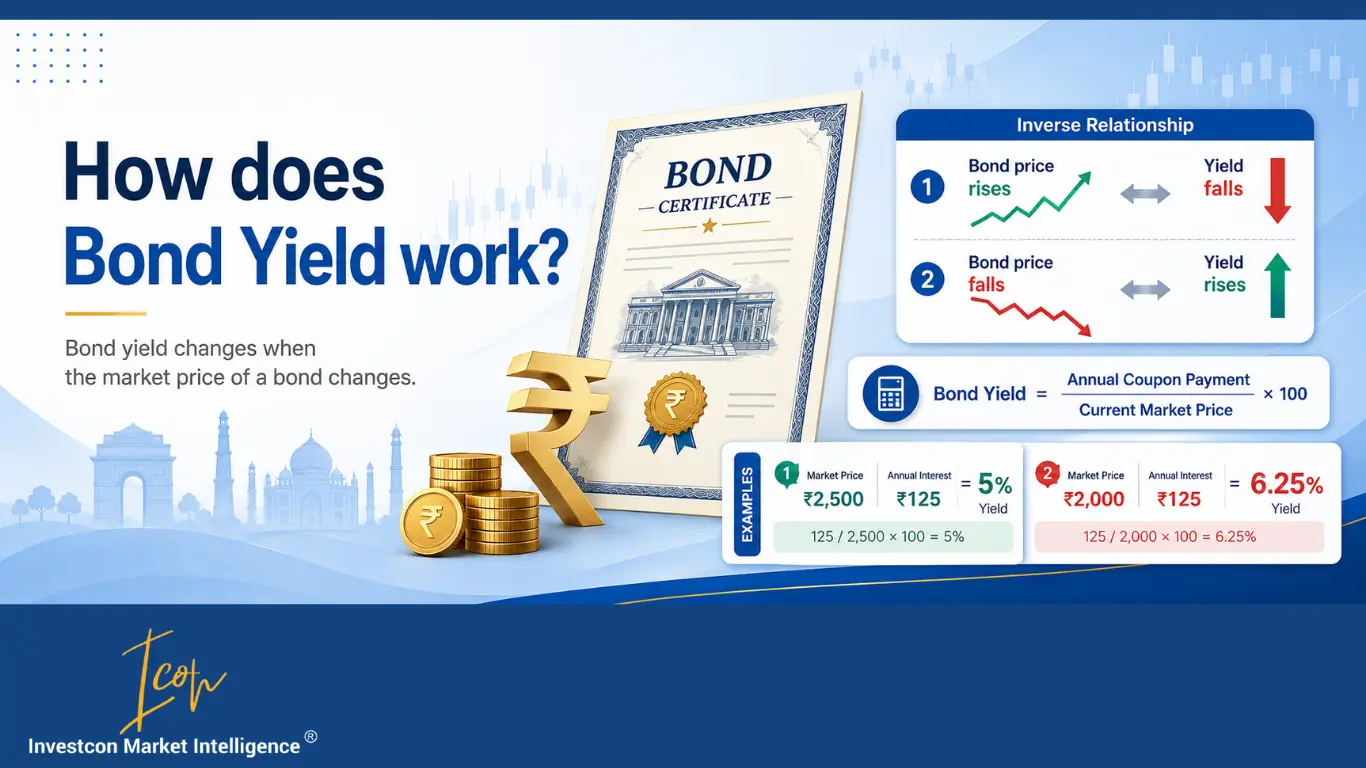
The calculation for bond yield includes a simple formula. The formula is given below.
Bond yield = (Annual Coupon Payment / Current market price)✖100%
Where,
Annual coupon payment is the annual interest payment earned on the bond.
The current market price is the current market value of the bond.
How does Bond Yield work?
The bond yield represents the total income earned from the investment based on its current market value. Although the issuer makes a uniform coupon payment regularly, the market value of the bond may change. The change may occur due to various factors such as inflation, market movement, demand, etc. Therefore, with the change in market value, the bond yield also changes.
When the market value of a bond increases, the yield decreases. It simply means that the investor has to pay more money to earn the same amount of fixed coupon interest. Similarly, when the market price of a bond decreases, the yield increases, because the investor could earn a similar interest payment at a lower purchase value.
Let us understand bond yield with the example of Miss Sujata.
Miss Sujata purchased a bond at an issue price of ₹2,500 at a coupon rate of 5% per annum. So, her coupon yield is 5%, and she receives an interest payment of ₹125.
After a few months, the current market value decreased to ₹2,000. And the interest received is still ₹125.
Now, the yield of that bond will be
125 ÷ 2000 = 6.25%.
Therefore, after comparing the yield rates of the bonds bought by Miss Sujata, it can be observed that the current market value of the bond decreased from ₹2,500 to ₹2,000, and the yield rate increased from 5% to 6.25%. This happened because she is earning more than the interest payment she would earn at its current value.
Bond Price vs Bond Yield
Although both bond price and bond yield are closely related, they work differently.
| Basis | Bond Price | Bond Yield |
| Meaning | It is the current market value of the bond | It is the income earned as per the current market value |
| Movement | It moves based on the market conditions and fluctuations | It moves based on the movement of bond price |
| Influencing factors | Market demand, inflation rate | Bond price, coupon payment |
How does Bond Yield affect your Investment?
The bond yield plays a vital role in investment because it affects the interest earned on a bond. A change in bond yield directly refers to a change in bond prices, interest payments, market value, etc.
When bond yields increase, the new bond issuers prefer to offer higher coupon rates, which results in old bonds with lower coupon rates being less attractive. This encourages investors to choose bonds with higher rates for a stable income or return.
However, when the bond yield decreases, the old and existing bonds with higher interest rates become more valuable, and investors may refuse to invest in new bonds. Also, when yield decreases, investors may prefer to choose other investment instruments rather than investing in a low-yield bond.
The change in bond yield usually indicates a change in the economic and market conditions. It may include market movements, new policies, inflation rate, interest rate, etc. Therefore, a change in yield results in investment decisions of the investors to balance their income stability and maintain their portfolio.
Common Mistakes Beginners Should Avoid
- Confusion between bond yield and coupon yield: This may be a very common mistake made by beginners. They confuse bond yield with coupon yield. Coupon yield is what you receive regularly on the return of your bond, whereas bond yield is what you earn compared to the current price of the bond.
- Ignoring inflation rate: Many new investors may ignore the impact of inflation on interest earnings. It estimates the purchasing power of the investor, considering the value of returns earned on that investment.
- Interest rate risk: New investors may often fail to understand the impact of interest rates. The bond prices are inversely related to market interest rates. When the market interest rates fall, the bond price usually rises, because newly issued bonds start offering low coupon rates and hence, old bonds with higher coupon rates become more valuable. On the other hand, when the interest rate rises, bond prices fall, because newly issued bonds offer high coupon payments. This makes the existing bonds with lower coupon payments less attractive to investors.
Conclusion
Bond yield plays an important role in helping investors understand the actual income earned from a bond, considering the interest earned annually and the current market value of the bond. While coupon yield stays consistent throughout the investment till maturity, the bond yield keeps changing as per the changes in the economy and market, such as inflation rate, interest rate, market price fluctuations, etc.
Therefore, bond yield helps investors to understand the value of the investment and make efficient investment decisions to gain a stable income, keep a diverse portfolio, and reduce the chances of loss.