


Investing ₹10,000 a month at 25 might not seem like a good investment plan to reach a substantial corpus. However, early investors, like those who begin investing in their 20s, have more time to compound their investment.
Imagine two friends, Arjun and Priya. Arjun waits until he is 35 and invests ₹20,000 per month, whereas Priya begins a Systematic Investment Plan (SIP) of ₹10,000 per month at age 25. Assuming an average 12% return, at 65, Arjun gets a ₹6.16 crore corpus, while Priya earns ₹19.58 crore. In both cases, we did not consider any step-up.
Therefore, despite investing less, Priya could earn more by investing early. This blog explains a detailed investment plan for a 25-year-old in India.
Benefits of Starting Investment in Mid-20s
Discussed here are the key reasons why investing in the mid-20s can be a good investment plan for investors.
- The power of compounding over long investment horizons:
Starting small but early gives investors access to compounding over a longer term. As explained in the example before, this strategy often gives better returns than investing late.
- Higher adaptability and risk tolerance:
At 25, people often have fewer dependents and less fixed commitments. This makes it easier to take higher risks that can offer better returns and take a patient stance during downturns. For example, a 25-year-old Amish can find it simpler to hold equities during market downturns rather than panic-selling.
- More economic independence:
At 25, people are usually in the initial stages of their career. Therefore, they are not as dependent on parents as they were as a teen. This gives them the financial freedom to make investment choices that suit them.
Step-by-Step Investment Plan for a 25-Year-Old in India
Here is a clear investment plan for a 25-year-old to follow. However, note that financial planning should be personalised based on individual goals and circumstances. While this guide can act as an outline, each investor should customise according to their needs.
Step 1: Build the Foundation Before You Invest
The first step is to get the financial must-haves right. Investors should focus on building an emergency fund and health insurance so that unforeseen circumstances do not hamper their financial journey.
- Create an emergency fund: An emergency fund helps sustain expenses in the case of sudden income loss or any other emergency situation. Consider the amount of money required to meet necessities for 3-6 months to set the target emergency fund. Suppose X requires at least ₹30,000 per month to live comfortably. Therefore, his emergency fund should have at least ₹90,000 to ₹1,80,000. To ensure that this money is available within a day or two, keep it in liquid assets or a savings account rather than long-term investments.
- Get suitable insurance: Health and term insurance should be considered for efficient financial planning. Term insurance is especially crucial in case an individual has any dependents.
- Clear any high-interest debt: Any high-value loan that makes savings difficult should be cleared before starting an investment journey. It makes disciplined and regular investments possible.
Step 2: Decide Your Financial Goals
Investors can have short, medium, or long-term goals. Before commencing any investment plan, an investor must know what they are investing for. The goal decides the choice of assets, tenure, and other crucial factors.
- Short-term goals: Such goals usually require short-duration debt funds, recurring deposits, and other assets that do not have high volatility in the short-term.
- Medium-term goals: A mix of hybrid and debt mutual funds or other similar allocation is usually preferred. At such intervals, equity can form a part of the portfolio but must be limited.
- Long-term assets: Equity and other growth assets usually stabilise market fluctuations in the long-term.
Step 3: Allocate Your ₹10,000 Monthly Investment
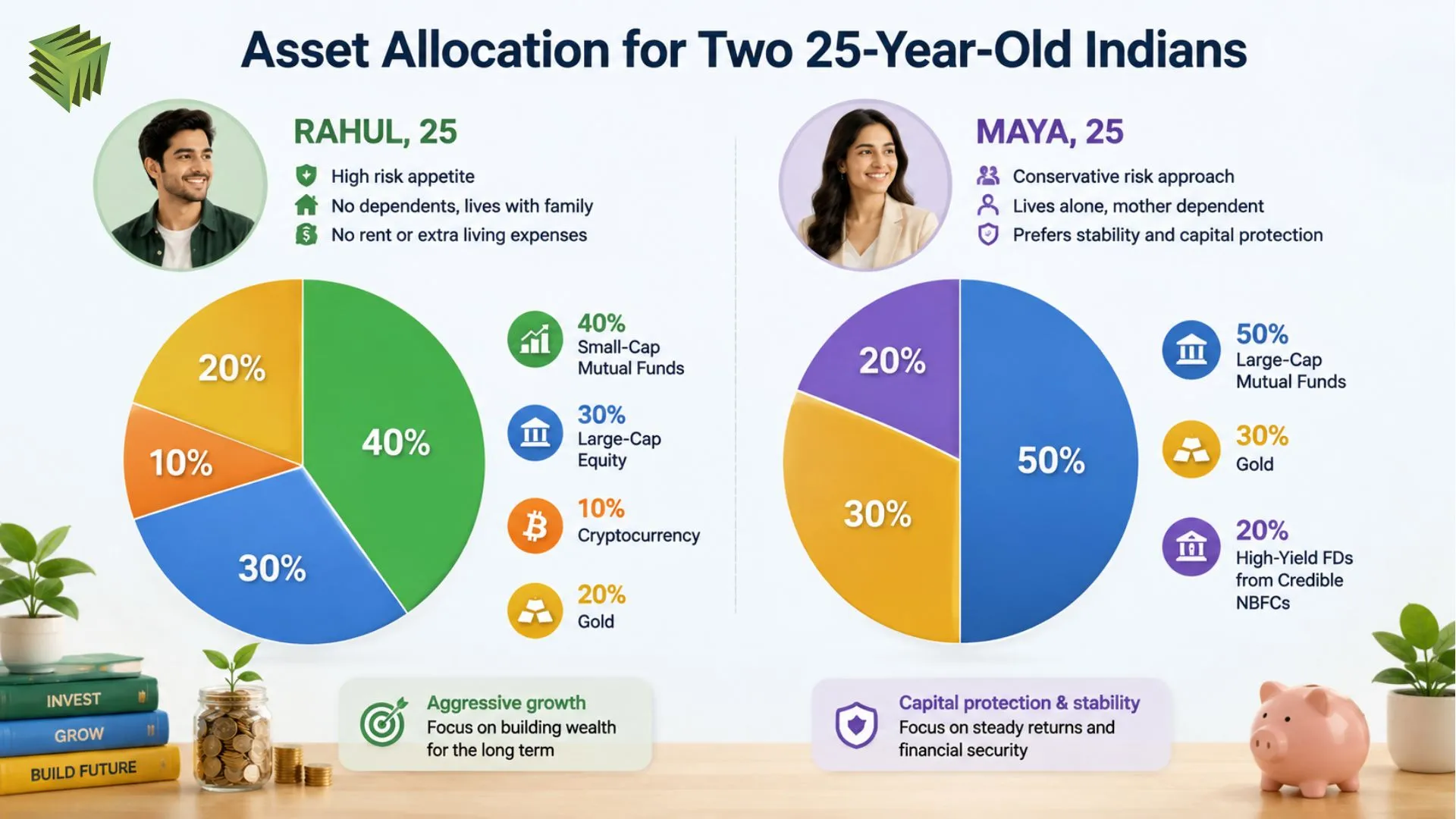
Once the goal is decided, investors should diversify their monthly contribution across different asset classes that suit their risk appetite and return goals. For example, 25-year-old Rahul has a high risk appetite because he has no dependents and lives with his family, resulting in no rent or additional living expenses. Therefore, he decides to invest 40% into small-cap mutual funds, 30% into large-cap equity, 10% into cryptocurrency, and 20% in gold. On the other hand, Maya lives alone and has her mother dependent on her income. Therefore, she wants a conservative portfolio allocation. She invests 50% into large-cap mutual funds, 30% in gold, and 20% in high-yield FDs from credible NBFCs.
Step 4: Review and Take Corrective Action
Investors must review their portfolio periodically to ensure that they deliver expected results. However, review must be done quarterly or annually, depending upon the nature of investments held.
- In case the concentration of high-risk assets increases due to capital appreciation, investors can liquidate and allocate into suitable assets to maintain overall portfolio health.
- In case an asset consistently underperforms while its peers in the same category are not, it can be a sign of an underperforming asset. Liquidating such an asset and allocating the proceeds into quality mediums can be helpful.
Step 5: Increase Your Investment Every Year
Investors should try to increase their investment periodically after income hikes and through step-up SIPs.
- Step-up SIP: As your income increases, raise your SIP amount by 10% to 15% annually. A 10% yearly increase on a ₹10,000 SIP creates a significantly larger corpus than a flat SIP without appearing to be a significant increase in any one year.
- Salary Hikes: Without altering your present living standard, you may expedite wealth growth by allocating even half of each yearly increase to your investments.
Common Mistakes a 25-Year-Old Investor Must Avoid
Here are some common mistakes you must avoid when investing as a 25-year-old:
- Postponing investments to wait for a higher salary.
- Following trendy stocks or engaging in Futures and Options (F&O) trading based more on social media advice than on analysis or a predetermined plan.
- Investing without emergency funds, which compels you to liquidate long-term holdings in an emergency.
- Failing to assess fund performance, asset allocation drift, and target progress on an annual basis.
- Ignoring inflation, which subtly reduces the profits on low-yield investments.
- Attempting to time the market rather than remain invested. Consistent SIPs beat most attempts to forecast market highs and lows.
Bottomline
For a 25-year-old Indian, an optimal financial strategy is to start as early as possible. Investors must create a safety net first, and maintain consistency in the long-term rather than trying to time the market. When invested carefully and expanded gradually, ₹10,000 per month has the ability to create a corpus that most individuals would spend their whole careers pursuing.
Key Takeaways
- Starting early matters more than starting with a heavy investable corpus.
- Split goals by timeline and match investments accordingly.
- Diversify based on your risk tolerance and goals.
FAQs
Is a lump sum investment better than a SIP for someone with a steady salary?
For salaried individuals, SIPs are usually more practical than lump sum investing. SIPs automatically buy more units when markets fall and fewer when they rise. This reduces the risk of investing a large amount right before a downturn.
What should I do in a month when I can’t invest the full ₹10,000 due to irregular income?
Most SIPs allow pausing for a few months without penalty, and some platforms offer flexible or skip-a-SIP options. Prioritise keeping the emergency fund untouched, invest whatever amount you reasonably can that month, and resume the full SIP as soon as cash flow normalises.
What if I have only ₹5,000 to invest per month?
Starting investment early is more important than investing a large amount. Even ₹5,000 can grow into a significant corpus over the long-term due to compounding.