

You can start investing in the stock market in India with ₹1,000 by buying an affordable share, an exchange-traded fund, or units of a mutual fund. The right route depends on how much research you can do, the risk you can handle and how long you can leave the money invested.
So, ₹1,000 is enough to begin.
But let us set one point clear. Your first ₹1,000 is unlikely to alter your finances overnight. Its real job is to get you started, teach you how investing works, and help you build a habit that can grow with your income.
With ₹1,000, your choices are limited, but they are still useful. You might buy a share in one company or put the money into a fund that holds several companies. The amount decides what is available. What matters more is understanding where the money is going before you invest.
For anyone searching for how to invest in the share market in India for beginners, this guide explains exactly where that ₹1,000 can go and how to invest it responsibly.
What Can ₹1,000 Actually Do in the Stock Market?
Before choosing an investment, it helps to understand what this starting amount can realistically achieve.
₹1,000 may look small beside the share prices and portfolio screenshots seen online. Still, it is real money, and it gives you real exposure to market movements.
It can help you:
- Learn how buying and selling work.
- Understand how prices move.
- Test your reaction to gains and losses.
- Develop a regular investing habit.
- Make beginner mistakes with a limited amount.
What it cannot do is create a properly diversified portfolio of several direct stocks. It also cannot produce a dependable monthly income or guarantee quick returns.
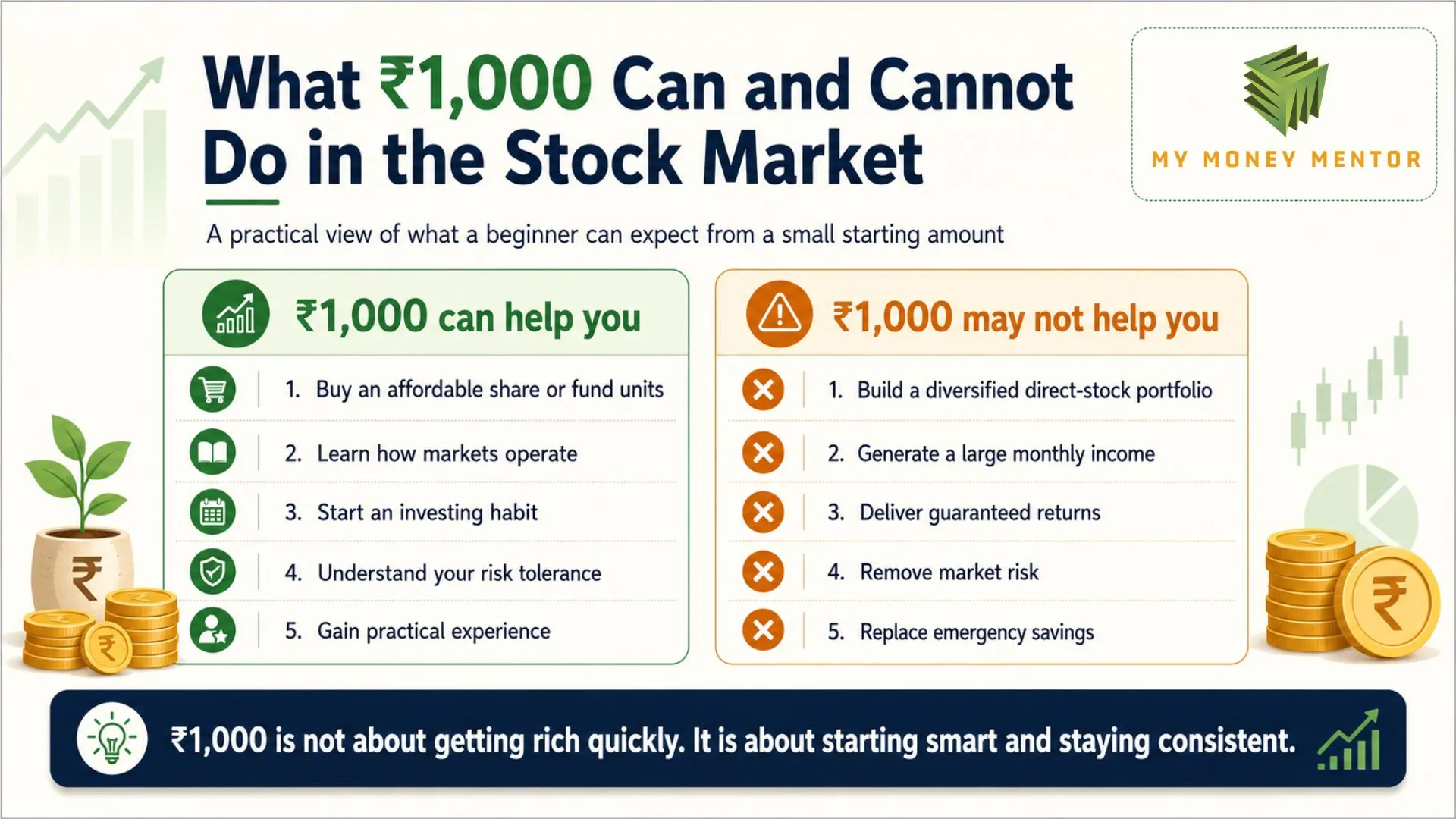
That does not make ₹1,000 a poor starting point. It simply changes what you should expect from it.
At this stock market start in India, the priority is to choose a route that gives you useful market exposure without concentrating the entire amount unnecessarily. You could buy an individual share, invest through an ETF or start with a mutual fund.
Each option gives you a different kind of start. The next section compares what ₹1,000 looks like across these three routes.
Step 1: Choose How You Want to Invest Your ₹1,000
There are several ways to participate in the securities market. When you are beginning with ₹1,000, however, it helps to narrow the choice to routes that are easy to access and understand.
For this guide, we will look at individual shares, ETFs and equity mutual funds. All three give you exposure to listed companies, but they handle your ₹1,000 differently.
| Route | What you invest in | Diversification with ₹1,000 | Your involvement |
| Individual shares | One or a few listed companies | Usually limited | Higher |
| ETF | A predefined basket of securities | Usually wider | Moderate |
| Equity mutual fund | A portfolio of listed companies | Usually wider | Lower |
Other investment products are available. We are focusing on these three because they let a beginner understand the basic trade-off between choosing companies directly and spreading the same amount across a wider portfolio.
Let us start with direct ownership.
Option 1: Buy Individual Shares
A share represents a small ownership stake in a company. When you buy shares of a listed business, the value of your investment moves with that company’s market price.
₹1,000 is enough to buy shares in many Indian companies. What changes is how many shares you can buy and how those companies perform over time.
Here are three familiar companies at different price points.
| Company | Price | What ₹1,000 could buy | Approx. amount used | 3-year return | 5-year return |
| HDFC Bank | ₹734.30 | 1 share | ₹734.30 | -3.9% | -0.2% |
| Tata Steel | ₹190.47 | 5 shares | ₹952.35 | 17.0% | 5.7% |
| NHPC | ₹77.50 | 12 shares | ₹930.00 | 16.2% | 24.2% |
Price and trailing-return data as of 6 August 2026. Returns over three and five years are annualised.
Note: These stocks are used only to show how share prices and past returns can differ. They are not investment recommendations, and past performance does not indicate future returns.
The first thing to notice is the number of shares ₹1,000 can buy. You could buy around 12 NHPC shares, five Tata Steel shares or one HDFC Bank share with the same starting budget.
But more shares do not automatically mean a better investment.
A ₹77 stock is not necessarily cheaper than a ₹734 stock. Share price only tells you the price of one unit. To judge whether a stock is expensive or reasonably valued, you also need to look at the company’s earnings, financial position and valuation.
The return figures need similar context.
NHPC delivered the highest five-year return among these three during this particular period. HDFC Bank’s five-year share-price return was slightly negative, while Tata Steel was in between.
That does not make one company stronger and another weaker.
HDFC Bank operates in banking, Tata Steel is exposed to the steel and commodity cycle, while NHPC operates largely in power generation. Their businesses respond to different economic conditions, industry cycles and company-specific developments.
The starting valuation also matters. A financially strong company can still deliver weak share-price returns over a particular period if its starting valuation was high or the market later reassessed its growth expectations.
The opposite can happen too. A stock may record strong historical returns after benefiting from a favourable business cycle or a change in how investors value the company.
So, use the table to understand how differently ₹1,000 can behave, not to decide which of these three stocks you should buy today.
Before choosing an individual share, check how the company earns money and whether its revenue and profit have been growing. Look at debt, cash generated from operations and the valuation at which the stock currently trades.
There is also one practical issue when you have only ₹1,000. Most of your money may still end up in one company, which leaves little room to spread the risk.
If you would prefer to distribute that ₹1,000 across several companies rather than depend on one business, an ETF gives you another way to do it.
Option 2: Buy an ETF
An ETF is an exchange-traded fund. It allows you to buy a unit representing a basket of securities instead of selecting every company individually.
To understand that, you first need to know what an index is.
An index is a rule-based group of companies used to represent a part of the stock market. The Nifty 50, for instance, follows 50 large companies rather than the performance of a single business.
An ETF can follow one of these indices.
If you buy a Nifty 50 ETF, your money is linked to the companies included in the Nifty 50. You do not need enough cash to purchase all 50 shares separately.
ETFs themselves trade on the stock exchange. Their unit prices move during trading hours, so ₹1,000 will buy only the number of whole units that fit within your budget.
Here is how three different ETFs looked around the same period.
| ETF | What it follows | Approx. value per unit | 3-year return | 5-year return |
| Nippon India ETF Nifty 50 BeES | Nifty 50 | ₹281 | 9.3% | 9.9% |
| Nippon India ETF Nifty Next 50 Junior BeES | Nifty Next 50 | ₹805 | 19.2% | 14.2% |
| CPSE ETF | Selected central public-sector companies | ₹95 | 26.5% | 29.5% |
Values and trailing returns are based on the latest available data around 5–6 August 2026. Multi-year returns are annualised.
Note: These ETFs are only example. They are not investment recommendations, and past performance does not indicate future returns.
The difference between these returns comes partly from what sits inside each basket.
A Nifty 50 ETF spreads money across 50 large companies. A Nifty Next 50 ETF follows the next set of large companies outside the Nifty 50. CPSE ETF is much narrower and is concentrated in selected government-owned companies.
The CPSE ETF had the highest historical return in this example. That does not make it the automatic choice for your ₹1,000.
A concentrated ETF can behave very differently from a broad-market ETF. The sector mix, company weights and market cycle all influence performance.
So before choosing an ETF, check the index it tracks first. Then look at its expense ratio, trading activity and tracking error, which tells you how closely the ETF has followed its benchmark.
The main advantage here is easier diversification. You are no longer depending entirely on one company.
If you do not want to buy ETF units through the exchange yourself, you can take a similar pooled approach through a mutual fund.
Option 3: Invest Through an Equity Mutual Fund
A mutual fund pools money from many investors and invests it according to the scheme’s stated investment approach.
Your ₹1,000 buys units in that portfolio. You do not need enough money to purchase every company held by the fund separately.
Mutual funds are available across several asset classes. Some invest in debt securities, while hybrid funds combine equity and debt.
Since we are discussing how to start investing in the stock market, we will stay with equity mutual funds here.
Even within equity funds, the type of companies in the portfolio can differ considerably.
Large-cap companies are the 100 largest companies by full market capitalisation. Mid-cap companies rank from 101 to 250, while companies ranked 251 onwards fall into the small-cap universe.
In simple terms, a large-cap fund concentrates mainly on larger established companies. A mid-cap fund moves further down the market-size range, while a small-cap fund goes further still.
That difference can show up in returns as well.
| Equity fund category | 3-year category return | 5-year category return | 10-year category return |
| Large Cap | 11.61% | 10.53% | 11.80% |
| Mid Cap | 18.51% | 16.16% | 15.65% |
| Small Cap | 17.40% | 15.81% | 16.44% |
Latest category returns available on 7 August 2026. Returns over periods longer than one year are annualised.
Here again, the highest number should not become the investment decision.
Mid-cap funds had the highest three-year and five-year category returns in this snapshot. Small-cap funds had the highest ten-year figure. Those rankings can change as market conditions change.
Smaller companies can also experience sharper price movements. A category that delivered more during one period can fall harder during another.
These figures are category averages, not the returns of every fund within that category. Two funds belonging to the same category can still deliver different results because their portfolios, costs and investment approaches differ.
That leaves you with three fairly different ways to use your ₹1,000.
- A direct share gives you control over the company you own, but the amount may remain concentrated.
- An ETF can spread the money across an index while still trading through the stock exchange.
- An equity mutual fund lets you invest an amount into a wider portfolio without selecting individual shares yourself.
Once you have chosen the route that fits you, the next step is choosing the right account to make the investment.
Step 2: Open the Right Investment Account
Your account set-up depends on whether you choose direct shares, ETFs or mutual funds.
To buy exchange-listed shares or ETFs, you generally need three connected accounts:
- A bank account to transfer money
- A trading account to place orders
- A demat account to hold securities electronically
Each one has a separate role. The bank account moves the money, the trading account places the order and the demat account holds the securities after purchase.
You do not open a demat account directly with a depository. It is opened through a registered Depository Participant, such as a broker, bank or financial institution.
Keep the Documents Ready
The account-opening process commonly requires:
- PAN
- Proof of identity
- Proof of address
- Bank details
- Mobile number
- Email address
- Photograph and signature, where required
KYC, or Know Your Customer, verifies your identity before the account becomes active.
You should also confirm that the broker or intermediary is registered. Do not open an account through an unfamiliar link received through a messaging group or social media page.
Compare Charges Before Choosing a Platform
With ₹1,000, even a small fixed charge can matter.
The demat investor charter states that no minimum balance must be maintained and no charge is payable merely for opening the demat account. However, brokers and Depository Participants may apply brokerage, annual maintenance, transaction or other service charges according to their published tariff.
Before opening an account, check the following:
| Charge | What it covers |
| Brokerage | Fee for executing certain orders |
| Annual maintenance charge | Cost of maintaining the demat account |
| DP charge | Applied by some providers when shares are sold |
| Exchange charges | Cost of using the exchange infrastructure |
| STT | Tax on specified securities transactions |
| Stamp duty | Duty collected on eligible purchases |
| GST | Tax on applicable services and charges |
For delivery-based equity transactions, STT is currently 0.1% on both the purchase and sale value. Stamp duty on the purchase of securities other than debentures on a delivery basis is 0.015%.
Do not assume that “zero brokerage” means “zero cost”. Statutory charges may still apply.
Your account is now ready. But having a buy button does not mean you should press it immediately.
Step 3: Research What You Are Buying
The purpose of research is not to predict tomorrow’s share price. It is to understand where your ₹1,000 is going.
This is where many beginner journeys go off track. A friend names a stock, a video shows a target price and the order is placed before the business is understood.
Pause there.
How to Research an Individual Stock
Start with the company.
Ask a basic question: what does this business sell and who pays for it?
If you cannot explain the answer in two simple sentences, research further before investing.
Next, review its financial performance using actual figures. Do not settle for statements such as “sales are rising” or “profits have improved”.
Look for numbers such as:
Revenue increased from ₹2,400 crore in FY2024 to ₹2,760 crore in FY2026, while profit after tax rose from ₹180 crore to ₹225 crore.
That tells you the scale, direction and period of the change.
Check at least three years of:
- Revenue
- Profit after tax
- Operating cash flow
- Total debt
- Interest costs
- Promoter shareholding
- Return ratios, where relevant
Company annual reports, financial results, shareholding patterns and official releases are available through exchange filing platforms.
Also study the risks. A company may have rising revenue but falling profit margins. Another may report profit while operating cash flow remains weak.
The point is not to find a perfect company. It is to understand what could go wrong before your money goes in.
How to Research an ETF or Mutual Fund
Fund research follows a different route because you are selecting a portfolio rather than one company.
For an index ETF or index fund, check:
- Which index it tracks
- What companies the index contains
- Expense ratio
- Tracking error
- Fund size
- Portfolio concentration
- Historical performance against the index
For an actively managed mutual fund, also review:
- Investment objective
- Portfolio composition
- Fund-manager tenure
- Risk level
- Exit load
- Performance over various market periods
Do not select a fund because it ranked first over one year. A short performance period may reflect temporary sector exposure or a particular market cycle.
You should also read the scheme information document and risk-related disclosures before investing.
Research helps you decide what to buy. Now comes the mechanical part: placing the order.
Step 4: Place Your First ₹1,000 Investment
The order process takes only a few taps, but each field deserves attention.
For a share or ETF, transfer the required amount from your linked bank account to your trading account. Then search using the correct company or ETF symbol.
Check the name carefully. Similar names can represent entirely different securities.
Choose Between a Market Order and Limit Order
The following order types are commonly used in exchange-based investing.
| Order type | How it works | Beginner consideration |
| Market order | Attempts to execute at the best available price | Final price may differ from the price displayed |
| Limit order | Executes only at the specified price or better | The order may remain unexecuted |
| Stop-loss order | Activates after a chosen trigger price is reached | More relevant to risk management and trading |
A market order focuses on execution. A limit order gives you greater control over price.
For example, suppose an ETF is trading around ₹245.
A market order may execute near that price, but the exact amount can change before completion. A buy limit order at ₹244 will execute only if sellers are available at ₹244 or below.
Before confirming, verify:
- Security name and symbol
- Quantity
- Order type
- Price
- Total amount
- Applicable charges
Once the trade is completed, the broker will issue a contract note with the transaction details. You should also receive confirmation from the exchange. Most equity trades in India follow a T+1 settlement cycle, which means the securities and funds are generally settled on the next working day.
Your ₹1,000 is now invested. The next question is what you should do after the first purchase.
Step 5: Turn the First ₹1,000 into a Regular Habit
One ₹1,000 investment creates experience. Regular ₹1,000 investments can create a portfolio.
That difference matters.
Suppose you make one ₹1,000 investment and it earns an assumed 10% annually for ten years. It would grow to around ₹2,594.
Now suppose you invest ₹1,000 every month for ten years at the same assumed annual rate. The illustrative value rises to about ₹2.07 lakh, while your total contribution is ₹1.20 lakh.
The result is driven by regular contributions as well as assumed growth.
| Monthly investment | Period | Total invested | Value at assumed 10% annual return |
| ₹1,000 | 5 years | ₹60,000 | Around ₹78,082 |
| ₹1,000 | 10 years | ₹1,20,000 | Around ₹2,06,552 |
| ₹1,000 | 15 years | ₹1,80,000 | Around ₹4,17,924 |
These are mathematical illustrations based on monthly investments at an assumed 10% annual return. Actual returns may be higher, lower or negative and are not guaranteed.
Monthly SIP contributions reached ₹31,781 crore in June 2026, showing that many investors prefer to invest in smaller amounts over time. Still, a SIP is only a method of investing. It does not guarantee that every scheme will produce the same return.
You can build the habit by:
- Investing on a fixed date each month
- Increasing the amount when income rises
- Reviewing the investment periodically
- Avoiding withdrawals for casual spending
- Recording why each investment was selected
Your early portfolio may grow more through contributions than through market returns. That is normal.
Before you begin adding money regularly, however, avoid the mistakes that can turn a useful learning experience into expensive bad habits.
Conclusion
You can start investing in the stock market in India through an individual share, ETF or mutual fund. The amount may be small, but the decision still deserves proper research.
Before investing, check what you are buying, understand the risks and account for transaction costs. An online stock research platform can also help you compare companies, study fundamentals and track stocks before putting your first ₹1,000 to work.
Do not judge the first investment by whether it makes a profit next month. What matters more at this stage is learning how to research, invest regularly and make decisions without reacting to every market movement.
Your first ₹1,000 does not need to find the market’s next winning stock. It needs to give you a sensible start.