
Every investment decision comes with a question: will the investment help meet their financial goals without taking on more risk than they can afford? This is where professional investment advice can make a difference. India had 1,065 SEBI-registered financial advisors listed as of 27 October 2026, but knowing how to choose an adviser is only part of the equation. Understanding their role, regulatory responsibilities and approach to investor suitability is equally important before seeking guidance for financial decisions.
Quick Answer:
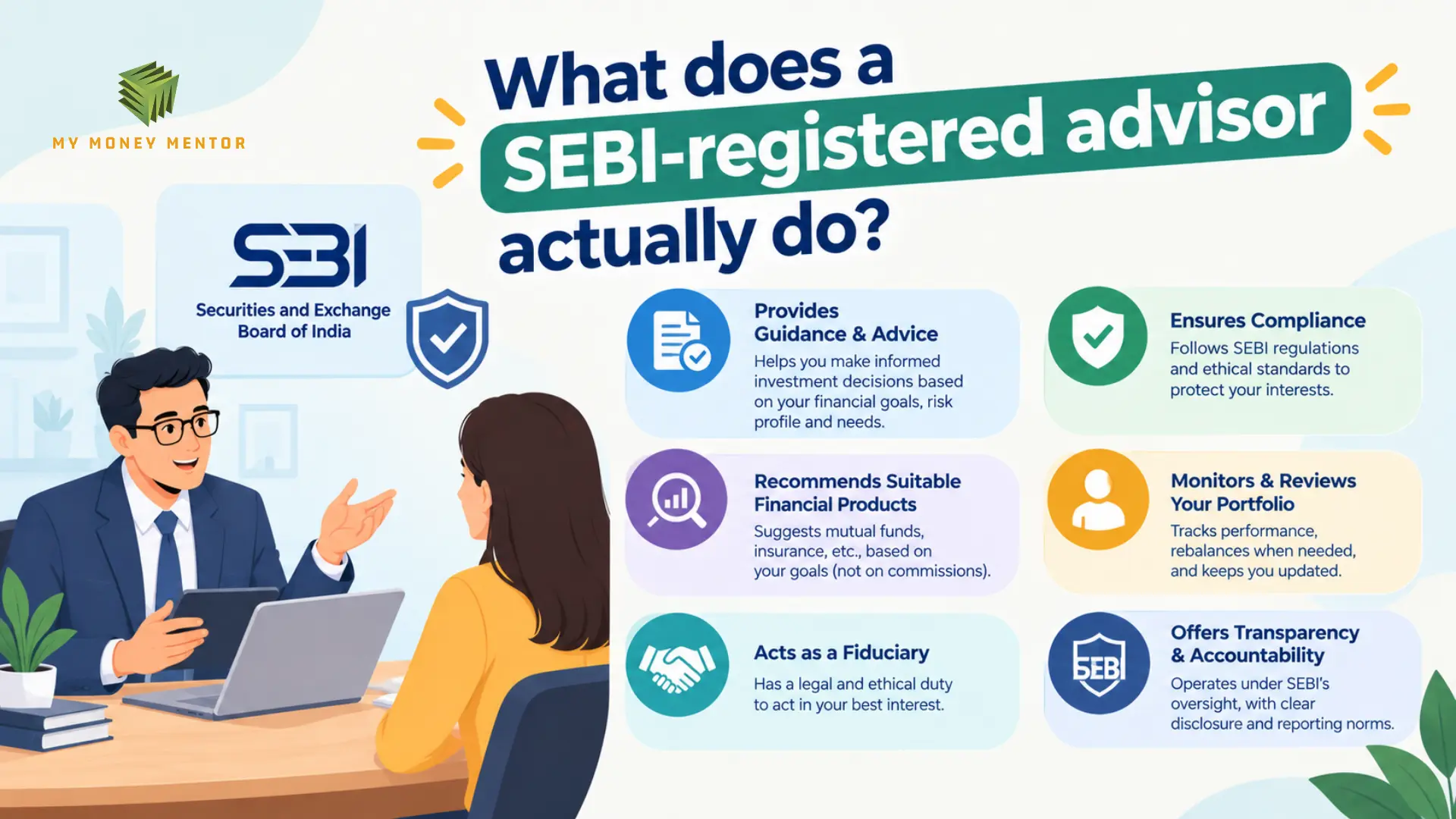
A SEBI-registered investment advisor helps investors make informed investment decisions based on their financial goals, income, investment horizon and risk tolerance. They assess risk profiles, recommend suitable investments, explain fees and potential risks, and disclose conflicts of interest. However, SEBI registration does not guarantee returns or remove market risks. Investors should verify the advisor’s registration, fees and service terms before seeking advice.
Key Takeaways
- A SEBI-registered Financial advisor understands the investor’s financial objectives, income, investment horizon, past investments, and risk profile, and then advises the investor accordingly.
- The investment advisor provides comprehensive information on investment risks, costs, conflicts of interest, and other vital details, while maintaining proper documentation in accordance with SEBI guidelines.
- SEBI registration does not guarantee returns or protect investors from losses due to changes in the market environment. Investors need to confirm the registration status and review the investment advisory agreement, fee structure, and related disclosures.
Who is a SEBI-Registered Financial Advisor?
The SEBI-registered financial advisor is more popularly known as a SEBI-registered Investment Advisor (RIA). This is the person who is registered with SEBI and advises on investments.
The investment advisors help the investors achieve their financial goals and know what risks they have. They advise them on investment options suited for the investor and also create a portfolio for him/her.
Key Responsibilities of a SEBI-Registered Investment Advisor

A SEBI-registered financial advisor has several responsibilities to ensure that investment advice is useful, transparent, and aligned with the client’s financial needs.
1. Understands the client before advising on investment
The very first obligation of a registered investment advisor under SEBI is not to advise on any investment but to understand the client himself. According to SEBI guidelines on risk profiling, a registered investment advisor is required to gather all the necessary information, such as the client’s age, investment objective, investment time frame, income, current investments/wealth, risk tolerance level, and liabilities/borrowings.
This is significant because the same investment product might not suit all investors. The ability to sustain a loss can differ from the readiness to take one. So, it is necessary to assess both factors when evaluating the client’s risk profile.
It is also necessary to make known the risk profile to the client at the end of this exercise. An advisory relationship thus begins with the information-gathering and risk assessment processes, not with a stock tip.
2. Makes appropriate investment suggestions
After understanding the client’s financial position and risk profile, the advisor assesses which investments the client could make. Investment advice must be appropriate to the client’s risk profile and aligned with the client’s investment objective and financial position.
It is expected that the advisor is aware of the nature and risks of the investments, and that there is a reasonable basis to believe that the suggested investment meets the client’s investment objectives, that the client has the capacity to take the risks, and that the client is sufficiently knowledgeable about the risks involved.
In other words, the advisor is not only supposed to identify investments that are favourable in the market. The advisor is required to tie investment suggestions to the client.
In the case of complex financial products, SEBI suggests that the advisor needs to analyse the product’s structure and risk-reward ratio in relation to the client’s knowledge, experience, investment objectives, and capacity to bear loss.
3. Advises on a variety of relevant investment choices
Registered investment advisors may provide personal investment advice in respect of securities products covered by the advisory service in question. Based on the nature of the investment advisor’s operations, the advice will focus on stocks, mutual funds, bonds, exchange-traded products, and other securities-market products.
It is important to note that investment advice should not only be personal but also tailored to the client, rather than general market commentary. The preparation of a research report on a particular stock in the securities market and the provision of personalised investment advice for a particular client cannot be the same thing.
Thus, the advisor will be able to assist the investor in making decisions regarding issues such as asset allocation, product choice, and portfolio construction.
4. Acts in fiduciary capacity
Fiduciary duty is one of the duties that a SEBI-registered investment advisory owes its clients. According to Regulation 15, the investment advisor must act in a fiduciary capacity and disclose any conflict of interest whenever it arises.
The advisor shall act in good faith, honestly, and for the benefit of its clients. There must be due care and diligence on the advisor’s part in providing advice based on careful analysis and consideration of the alternatives.
It is important because investment advisory services involve significant financial implications. It means that the advisor’s duty does not stop at generating business or promoting certain products.
5. Risk,costs, and fees explained
It is also the responsibility of a SEBI-registered investment advisor to make the right disclosures. As per the SEBI Investor Charter for Investment Advisors, the client agreement must include information on fee structure, disclosure of conflicts of interest and confidentiality clauses. Advisors must disclose their business, associations, and remuneration.
Transparency plays an essential role in the advice process. Instead of focusing the client solely on investment gains, the advisor must inform the client about the risks involved. Risks in investment decision-making include market risk, credit risk, liquidity risk, concentration risk, and so on.
Transparency of fees should also be considered. SEBI allows investment advisors to collect fees under certain fee structures. The maximum fixed fee for individual/HUF clients under the fixed fee model is currently set at ₹1,51,000 per family per annum.
On the other hand, under the AUA model, the maximum applicable fee limit would be 2.5% of AUA per family per annum. Advance fees have also been allowed by the SEBI guidelines for 2025. Such fees may be collected for up to one year if an agreement has been made with the client.
What Services Are Outside the Role of a SEBI-Registered Advisor?

Before understanding the limits of investment advisory services, it is important to know what a SEBI-registered advisor is not authorised or expected to do. This helps investors to understand the scope of the advisor’s role.
Do not guarantee fixed returns:
An application to SEBI does not necessarily mean that the advisor can guarantee gains to their clients. Even though investment advisors provide regulated advice, investment in the securities market may still carry risks.
Thus, when seeking advice from an investment advisor, the investor must distinguish between regulated investment advice and guaranteed returns.
Does not automatically control the investor’s funds:
The roles of an investment advisor and a portfolio manager are distinct. The former essentially acts as an advisor for making investments. Being registered as an investment advisor does not give an individual the authority to control the investor’s funds or the account itself.
In this regard, it is the responsibility of investors to know precisely what service they are seeking and what permission they are granting to the service provider.
Does not mean that every recommendation of stocks is suitable:
Registration with SEBI does not mean that all the stocks recommended by the advisor will be appropriate for all kinds of investors.
The advisor must first consider the investor’s financial position and investment objectives, as well as the investor’s risk profile and tolerance, before recommending any stocks. That which is appropriate for one investor may not be for the other, as they have different requirements and risk tolerance.
The investor must be made aware of the rationale for recommending that particular stock and whether it is suitable for fulfilling his financial objectives.
Working With a SEBI-Registered Advisor: Must-Know Checklist
Prior to using the services of any investment advisor, the investor must ascertain whether the individual or firm in question is registered with SEBI and what their registration particulars are.
The requirement under the SEBI Investor Charter is that the investment advisor should put up such particulars on its website.
The following points are useful when evaluating an advisory relationship:
| Area to check | What an investor should understand |
| SEBI registration | Verify the advisor’s registration status and details |
| Client Agreement | Check the service fees, disclosures, and other terms |
| Risk profiling | Understand how the advisor determines risk capacity and tolerance |
| Suitability | Check whether recommendations are linked to financial objectives |
| Fees | Understand the fee mode and applicable charges. For individual applications, the fee is ₹ 2,000, and for body corporate it is ₹10,000 |
| Grievances | Know the advisor’s complaint-handling and escalation process |
Conclusion
The task of the SEBI-registered financial advisor is to guide the investor through the decision-making process, keeping in mind their financial objectives, risk-bearing capacity, investment period, and current financial standing.
It is the duty of the investment advisor to provide proper advice to investors, explain the risks and costs involved, any other possible conflicts of interest, and maintain proper record-keeping.
However, the fact that an investment advisor is registered with SEBI does not in any way guarantee returns or eliminate the risks associated with the investments made.
FAQs
Q: Will a SEBI-registered investment adviser be able to give me investment advice depending upon my monthly income?
Ans: The SEBI-registered investment advisers consider your income, expenses, financial objectives, current investments, and risk-taking capacity to provide you with advice. This way, they would be able to know which kind of investments are appropriate for you.
Q: Would an SEBI-registered investment advisor be able to help me review my existing portfolio?
Ans: An SEBI-registered investment advisor can review your current portfolio considering your financial goals and risk profile. This will help you identify any concentration risk, inappropriate investment, and things to improve. The level of portfolio review will be dependent on how much both the client and the investment advisor agree on it.
Q: What are the kinds of documents required from my side while approaching an SEBI-registered investment advisor?
Ans: Some of the types of documents required from your side include KYC documents, income documents, details of existing investments, financial obligations, and investment goals.