


Summary
- Applying for an IPO in India using UPI or ASBA facilitates convenience and speed.
- An application for an IPO using the UPI method is submitted through the broker’s platform, while an application using the ASBA method is submitted through bank facilities.
- The application amount is blocked in the investor’s account until shares are allotted, rather than being paid immediately.

An Initial Public Offering (IPO) is the first public offer of shares by an unlisted company. It may include newly issued shares, shares sold by existing shareholders, or both. Investors can subscribe to these shares during the IPO period and become shareholders of the company upon successful allotment. An IPO is a capital-raising process that enables a private company to convert into a public company by offering its shares to the public.
Proceeds from a fresh issue may be used for purposes such as expansion, debt repayment or working capital. In an offer for sale, the proceeds are received by the selling shareholders. This allows investors to become a company’s shareholders.
Applying for an IPO in India has become easier due to the digitalisation of the application process. Investors can apply through bank ASBA or use the UPI mechanism under ASBA through an eligible intermediary. SEBI regulates both methods of application for an IPO in India. These methods facilitate blocking funds from an investor’s account and do not deduct them until shares are allocated.
To apply for an IPO through either the UPI or ASBA method, investors require a valid PAN, a demat account and an eligible bank account. A broker or trading account is also required when applying through a stockbroker’s platform.
Apply for an IPO using UPI
Nowadays, UPI is a popular mode for transactions in India. It simplifies the transaction processes. The UPI mechanism has made IPO applications more convenient for investors by allowing the application amount to be blocked in their bank accounts. This ensures that the funds are not deducted until the allotment of shares is finalised. It is a completely digital process that eliminates the need for any physical paperwork. It helps investors to track the process easily through a brokerage app or website.
Apply for an IPO using ASBA
Application Supported by Blocked Amount (ASBA) is a banking facility that enables investors to apply for an IPO through their net banking portal while keeping the application amount blocked in their bank account until the allotment process is completed. The funds remain in the investor’s bank account under a blocked status and are deducted only when shares are allotted. In this method, the bank does not debit the amount; instead, it blocks the amount in the investor’s account and debits it when the shares are allocated. It is considered a safe and secure IPO application method, as the application amount remains blocked in the investor’s bank account until the allotment process is completed. The ASBA facility is available through many banks in India.
Step-by-step application through UPI
The steps to apply for an IPO in India using UPI are mentioned below.
Step 1: Log into the broker’s platform: Log into the registered stockbroker’s brokerage app or platform.
Step 2: Select the IPO: Select the IPO company whose shares you want to apply for. Check the IPO details carefully before selection.
Step 3: Enter bid details: Fill in the necessary details such as the investor category, number of shares, share price and size, and your registered UPI ID.
Step 4: Approve the UPI mandate in the UPI app: After submitting your bid details, you will receive a mandate request on your UPI app. Review the mandate details and approve the block mandate request to authorize the blocking of funds for the IPO application.
Step 5: Submit the application: After the bid is submitted, the sponsor bank sends a UPI mandate request. Approving the mandate authorises the bank to block the application amount. You can monitor the status of their IPO application directly through the broker’s platform or mobile application.
Step 6: Allotment of shares: After the IPO closes, the company allocates the shares. If shares are allotted to you, then the blocked money will be automatically deducted from your account. If not, the blocked amount will be released back to your account.
Step-by-step application through ASBA
The steps to apply for an IPO in India using ASBA are mentioned below.
Step 1: Log into the netbanking portal: Log in to your bank’s net banking portal or mobile banking application using your registered user ID and password to access the ASBA facility.
Step 2: Navigate the IPO section: Locate the IPO or ASBA section, mostly found under investments, demat and ASBA services, etc.
Step 3: Select the IPO: Check the IPO details and choose the IPO that you are interested in.
Step 4: Enter bid details: Fill in the bid details such as investor category, lot size, price, and your registered PAN card.
Step 5: Submit the application: Review your bid and authorise the bank to block the amount from your bank account and complete the submission of your application.
Step 6: Allotment of shares: The shares are allotted after the IPO closes. If you receive an allotment of shares, the bank will automatically deduct the blocked amount from your account. And if no shares are allotted, then the block amount will be available for normal use.
UPI vs ASBA
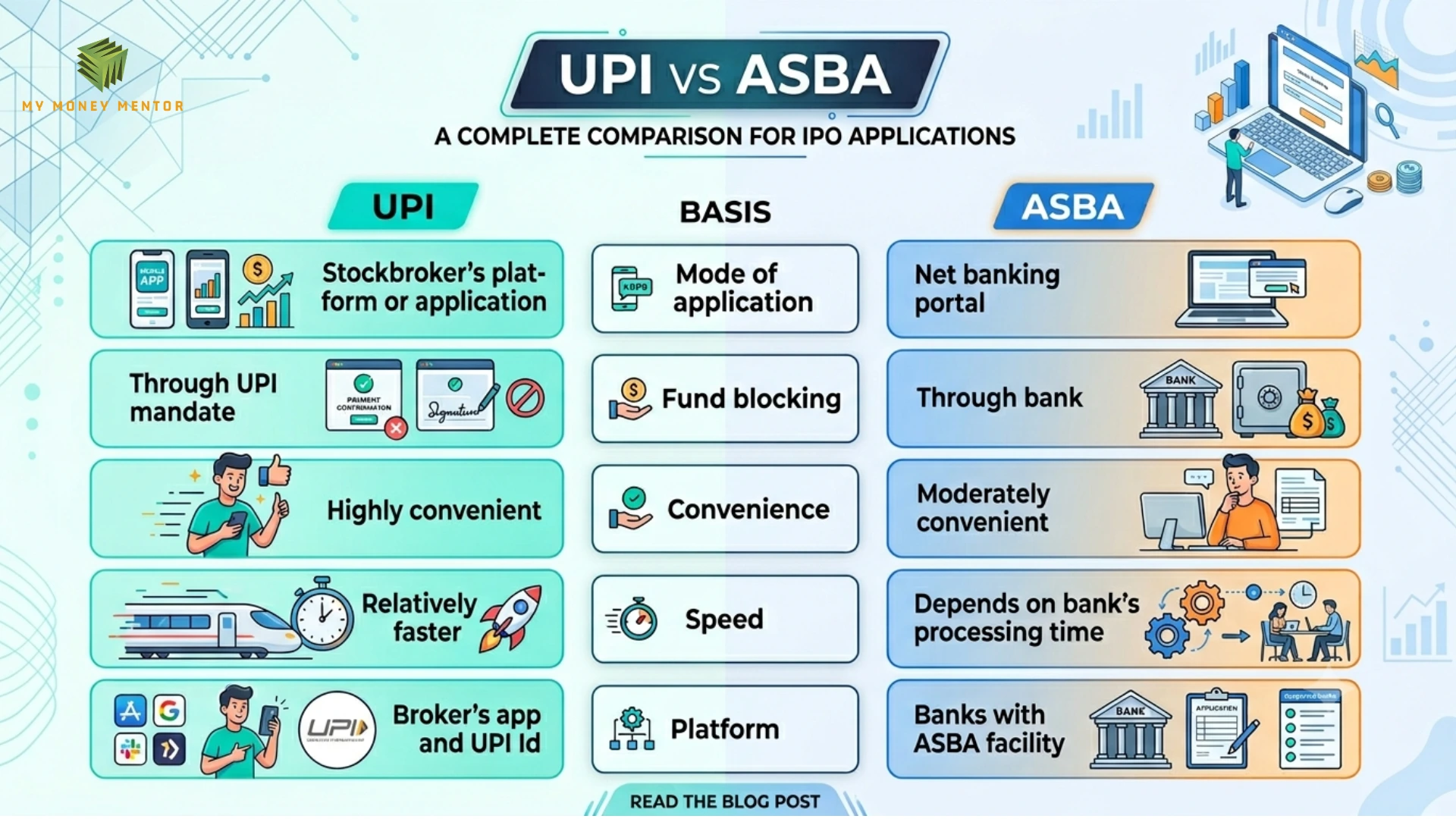
The difference between the UPI and ASBA methods of application is mentioned below.
| Basis | UPI-based ASBA | Bank ASBA |
| Application channel | Eligible intermediary, commonly a broker platform | SCSB net banking, mobile banking or designated branch |
| Authorisation | UPI mandate and UPI PIN | Bank ASBA authorisation |
| Application limit | Up to ₹5 lakh for individual investors | Subject to the issue, investor category and bank rules |
| Eligible users | Individual investors within the UPI limit | All eligible investor categories |
| Fund handling | Amount blocked in the bank account | Amount blocked in the bank account |
Key Fundamentals before applying for an IPO
The key fundamentals that investors need to consider before applying for an IPO are mentioned below.
- Company fundamentals: Investors should understand the business model of the company, which explains how the company is generating money, outperforming its competitors, and improving its growth. Investors should evaluate the skills, experience, and track record of the management team, as strong leadership plays a crucial role in the company’s long-term growth and success. Also, it is very important to check the use of the raised funds.
- Financial performance: Investors should evaluate the company’s financial performance by analyzing key indicators such as revenue growth, profitability, cash flows, and debt levels to assess its financial strength and future growth potential. Analyse the financial statement and financial position of the company.
- IPO details: Review the red herring prospectus issued by the company about the IPO. It includes information regarding the issue size, total amount of IPO, lot size, objectives of the IPO, and promoters of the company. It shows the reason behind the raising of funds from the public, such as improved working capital, repayment of debt, or growth and expansion of the company.
- Market conditions: Investors need to understand the changing nature of the market. The overall market condition and demand of the market influence the IPO demands and affect the performance of the IPO. Evaluate the macroeconomic factors to select an IPO and make an effective investment decision.
Benefits of using the UPI and ASBA methods
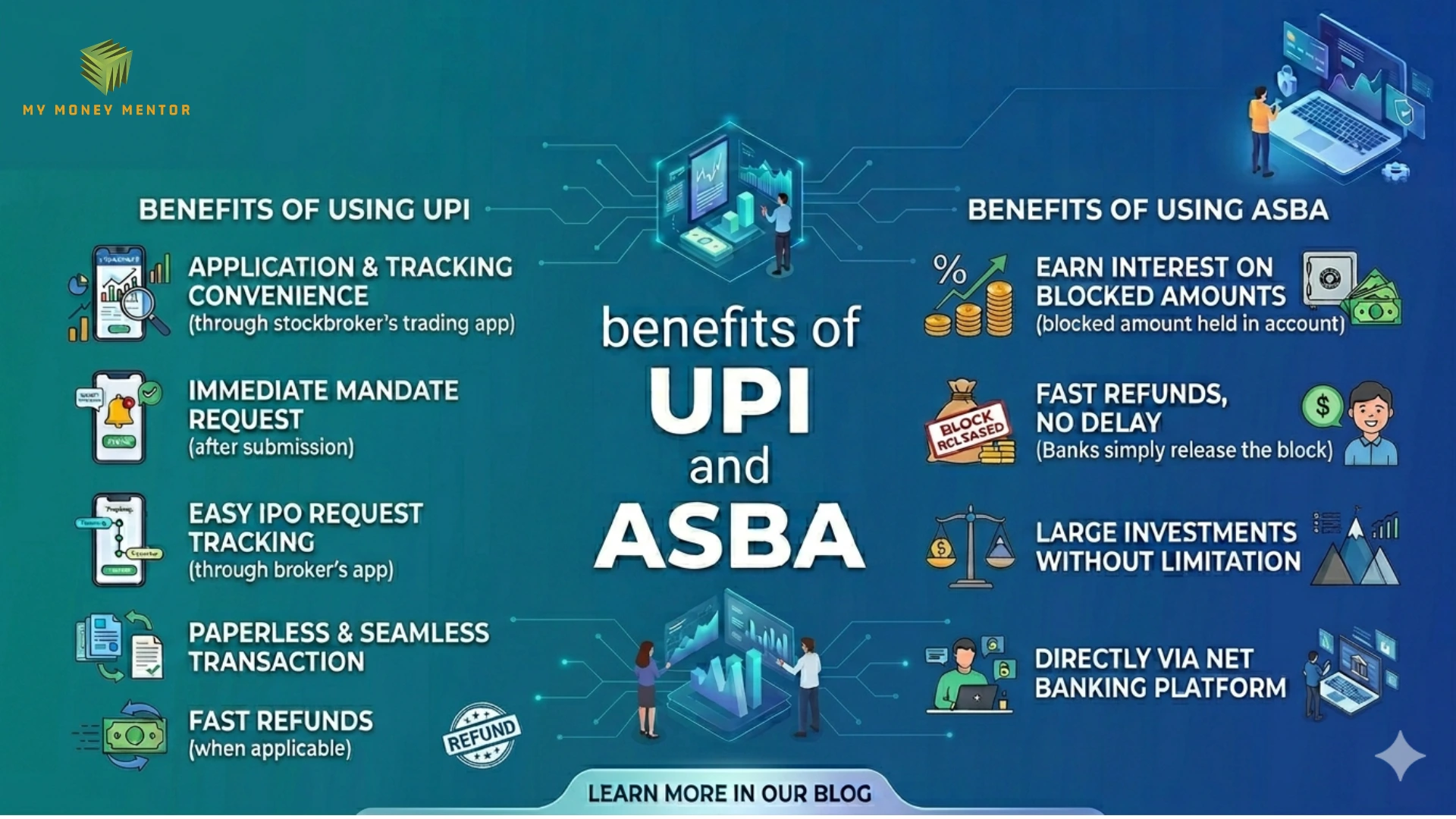
There are several benefits of using the UPI and ASBA methods for applying for an IPO in India. Some of them are given below.
| Benefits of using UPI | Benefits of using ASBA |
| Since the application is done through stockbroker’s trading app, the application and tracking process becomes convenient | Since the blocked amounts are still held in the account, investors may still earn interest on them |
| The UPI mandate request appears immediately after submitting the application | If the shares are not allotted, the refunds do not take a long time. The banks simply release the block and it becomes ready to be used normally |
| Tracking the IPO request is easier in UPI method through broker’s app | Most ASBA allows investors to apply for large investments without any limitation |
| This is paperless transaction, that helps investors to manage the application seamlessly | ASBA can be done directly through the bank’s net banking platform |
Common Mistakes to Avoid
The common mistakes made by investors while using the UPI and ASBA methods for applying for an IPO in India are mentioned below.
Mistakes made while using UPI
- Not updating the UPI mandate: Many investors forget to update their UPI mandate. After submitting the application, the mandate request appears immediately on the UPI app. Investors need to accept the block mandate request.
- Entering the wrong UPI ID: Making mistakes while filling in the UPI details might lead to cancellation of the mandate request, which is essential to complete the application process.
- Third-party errors: Investors need to put UPI details registered in their own name, according to the guidelines of SEBI. Using someone else’s UPI ID may lead to rejection of the application.
- Insufficient bank balance: The bank may decline the amount blocking if investors do not have enough balance in the account during the process of mandate.
Mistakes while using ASBA
- Incorrect details: Any minor mistake in the details of the demat account or bank account numbers may lead to rejection of the entire application process
- Mismatched PAN card details: If the PAN card details do not match the other important details of the investors, the application request may be declined.
Conclusion
Using UPI and ASBA methods for applying for an IPO in India has become relatively convenient. It facilitates a fast and efficient way to apply for an IPO. It helps investors by not deducting the application amount immediately. Rather, it blocks the amount and deducts only when the shares are allotted. In case no shares are allotted, the amount is released to be used as the normal amount.
Although it is convenient, many investors make mistakes while filling in the details, such as providing incorrect details, not having sufficient bank balance, not approving block mandate requests, etc. This leads to rejection or failure of the application request. Overall, applying for an IPO through UPI and ASBA is convenient and also provides seamless tracking of the request process.
FAQs
What is ASBA in an IPO application?
ASBA (Application Supported by Blocked Amount) is a facility that allows investors to apply for an IPO by blocking the application amount in their bank account. The amount is debited only if shares are allotted.
What are the UPI methods in an IPO application?
The UPI method allows investors to apply for an IPO through a broker’s platform and authorise a UPI mandate request to block the application amount until allotment is completed.
Which one is better: ASBA or UPI?
Both methods are secure and SEBI-approved. UPI is suitable for retail investors due to its convenience and mobile-based application process, while ASBA is suitable for investors who prefer applying through their bank accounts.
Who is eligible to apply using the UPI for an IPO?
Individual investors can use UPI for IPO applications of up to ₹5 lakh. Applications of up to ₹2 lakh fall under the retail category, while applications above ₹2 lakh and up to ₹5 lakh fall under the non-institutional investor category.
Is applying through ASBA or UPI safe?
Yes. Both ASBA and UPI-based IPO applications are regulated mechanisms that ensure investor funds remain blocked in their bank accounts and are debited only if shares are allotted.