

Paper trading is a useful way for beginners to learn about the stock market without risking real money. It allows users to practise trading strategies, understand price movements, and monitor hypothetical profits and losses using virtual funds. However, many beginners make mistakes that limit their learning and create unrealistic expectations about live trading.
Using a paper trading app India traders choose can help build practical knowledge, but the results depend on how effectively they use the platform. Simply placing random trades and watching virtual profits increase will not necessarily improve trading skills.
In this article, we discuss the common mistakes to avoid when using a paper trading app and explain how to make your practice sessions more productive.
Quick Answer:
Paper trading apps in India help beginners practise trading without risking real money. To get the most out of them, use a clear strategy, manage virtual risk, check market data accuracy, account for trading costs, and maintain a trading journal. Focus on learning and consistency rather than virtual profits, as simulated results do not guarantee success in live trading.
Common Mistakes to Avoid
1. Trading Without a Proper Strategy
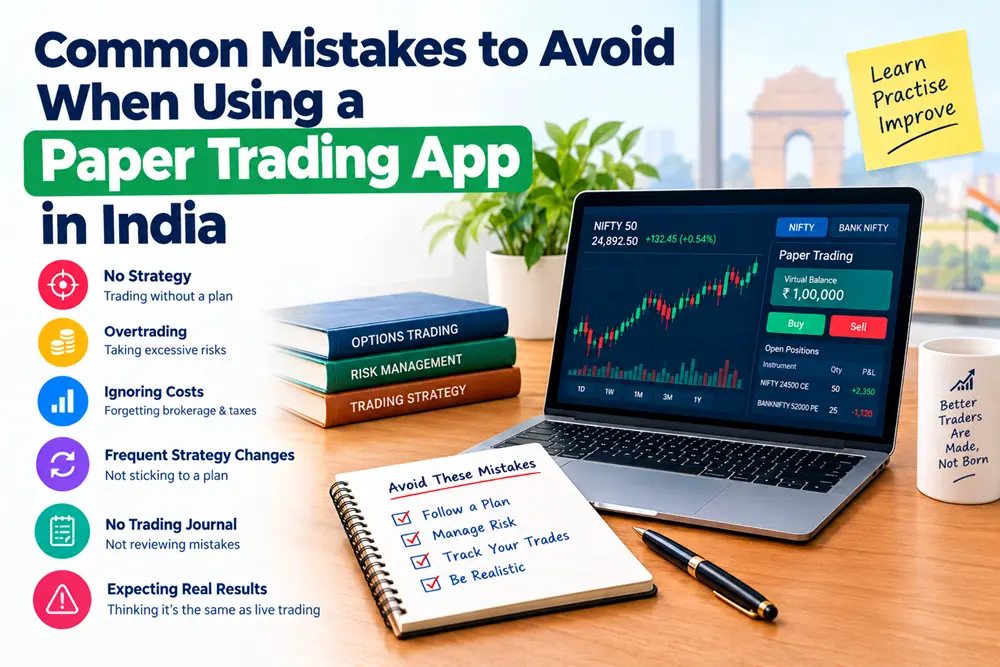
One of the most common mistakes beginners make is placing trades without a clear plan. They may buy an option because its price is moving upward or sell a position because the market suddenly turns negative.
This approach does not help develop consistent trading habits.
Before entering a simulated trade, define your entry conditions, exit point, target, and stop-loss. Also, write down why you are taking the trade. Following a structured plan makes it easier to evaluate your decisions later.
2. Taking Excessive Risks With Virtual Money
Since paper trading uses virtual funds, beginners sometimes take unusually large positions. They may use their entire simulated balance on one trade because they believe there is nothing to lose.
However, this habit can create unrealistic expectations about risk management.
Treat virtual money as if it were your actual trading capital. Practise sensible position sizing and decide how much you would be willing to risk on a hypothetical trade. This approach can help you develop more disciplined habits before considering live trading.
3. Ignoring Market Data Accuracy
Not every simulator provides real-time market prices. Some platforms use delayed data or simulated prices, which can affect the accuracy of your practice results.
This is particularly important when practising index options, where premiums may change quickly.
Before using a platform, check whether its prices are live, delayed, or simulated. A paper trading app India users select should clearly explain its market data sources and limitations.
Never assume that a simulated order will execute at the same price or speed as a real order.
4. Focusing Only on Profits
Another mistake is judging trading performance entirely by virtual profits. A beginner might complete several profitable trades and assume that their strategy is successful.
However, a few winning trades do not establish that a strategy is reliable.
Instead, review your decision-making process. Check whether you followed your trading rules, managed risk, and avoided impulsive entries. Track both winning and losing trades to understand what works under different market conditions.
The goal of paper trading is to improve your knowledge and discipline, not simply to produce impressive virtual returns.
5. Ignoring NIFTY Options Risks
Many beginners use nifty paper trading to understand index options. Although this practice can be educational, options involve additional factors beyond the direction of the market.
Option premiums are affected by the underlying index price, time remaining until expiry, implied volatility, and other factors.
For example, a call option may lose value even when the index moves slightly upward if time decay or changes in implied volatility outweigh the favourable price movement.
Learn how strike prices, premiums, expiry dates, and the options chain work before testing complicated strategies. Remember that buying options can result in losing the entire premium paid, while selling options can involve substantially larger losses.
6. Forgetting Brokerage and Trading Costs
Some beginners calculate their simulated profits without accounting for brokerage, taxes, and other transaction costs.
This can make a strategy appear more profitable than it would be in live trading.
Whenever possible, use a simulator that allows you to include estimated trading costs. Review the applicable charges for your intended market and trading activity.
Even if a strategy generates positive gross returns, costs may reduce the final result. Understanding this difference helps you evaluate simulated performance more realistically.
7. Switching Strategies Too Frequently
Beginners often change strategies after a few losing trades. They might try a new indicator, follow a different trading method, or copy a strategy they recently discovered online.
Constantly changing approaches makes it difficult to determine whether a strategy is effective.
Instead, choose a simple method, define its rules, and test it across a meaningful sample of simulated trades. Record the results and identify recurring strengths and weaknesses before making adjustments.
Remember that no strategy works in every market condition, and historical or simulated performance does not guarantee future results.
8. Not Maintaining a Trading Journal
Trading without recording your decisions makes it difficult to identify mistakes and measure progress.
Maintain a journal containing the date, instrument, entry price, exit price, strategy, and outcome of every simulated trade. Include your reason for entering and whether you followed your plan.
Review the journal weekly. Look for patterns such as entering too late, exiting too early, or repeatedly ignoring stop-loss levels.
This simple habit can turn paper trading into a structured learning exercise.
Conclusion
A paper trading app can help beginners understand the Indian stock market, but its benefits depend on how it is used. Avoid trading without a strategy, taking excessive virtual risks, ignoring transaction costs, and judging success only by profits.
Whether you are exploring index options through nifty paper trading or comparing a free paper trading app India offers, focus on realistic practice, consistent rules, and regular performance reviews.
Most importantly, remember that paper trading is an educational tool, not a guarantee of future profits. Developing disciplined habits and understanding risk are more valuable than achieving impressive virtual returns.