

An IPO (or “Initial Public Offering”) gives you a chance to buy shares in a company at the same price offered to the “institutional investors”. That is the pitch, and it is why every new issue draws a crowd of first-time applicants, a flurry of broker notifications and a stream of forwarded messages about “listing gains.”
Keeping an eye on an IPO and checking if it’s worth your money are two different things. One means knowing the opening date, price band and allotment dates. The other means checking if the company is worth the price it has set. Many people keep track of dates but don’t look into the business.
Later, they may end up with shares in a company they know little about. The dates tell you when to apply, but the offer documents help you decide if it’s worth applying at all. What follows is the process I would use on any mainboard issue, in the order that wastes the least time.
Key Takeaways:
- Understand the company’s business and growth potential.
- Check financial performance, debt and cash flow.
- Compare IPO valuation with listed competitors.
- Review risks and don’t rely only on GMP or subscription data.
What Is an Upcoming IPO?
An IPO is upcoming from the day a company files its “Draft Red Herring Prospectus (DRHP)” with SEBI until bidding opens. That can be weeks or months. The “Red Herring Prospectus (RHP)” follows once SEBI’s observations are addressed.
You usually get the price band and lot size details a few days before the IPO opens. The application window stays open for three working days. Once it closes, the stock is listed on the exchange three working days later.
An IPO can help “fund expansion” to companies, “pay off loans”, or cover their “daily expenses”. In addition, it can also give early investors a chance to sell some of their shares.
The official documents are public. The DRHP and RHP sit on SEBI’s website and on the websites of the lead managers, and exchange notices on NSE and BSE carry the final dates. If you’re an investor looking to track upcoming IPOs, on “Malik Times”, you can compare announced dates, price bands and issue details before beginning a deeper evaluation. You should treat any date from a secondary source as provisional until it matches the RHP.
What Is a Mainboard IPO?
A “mainboard IPO” is a public issue by a company that lists on the main segment of NSE or BSE. The label actually describes where the stock trades, and not how good the company is. A profitable fifty-year-old manufacturer and a fast-growing, loss-making technology company can both list there.
Mainboard IPO vs SME IPO
SME IPOs are listed on NSE Emerge or BSE SME and usually involve smaller businesses. They differ from “mainboard IPOs” in company size, trading volume and the amount needed to apply. A mainboard lot may cost around ₹14,000 to ₹15,000, while an SME IPO often requires ₹1 lakh or more. SME stocks can also be harder to sell if there aren’t enough buyers. The rules for applying aren’t the same for every IPO, so check the latest requirements on the exchange website before you apply.
Why Mainboard IPOs Attract Attention
Several things draw people in. Some issuers have long operating histories. Institutions such as “mutual funds” and “insurers” apply through their own category. Disclosure is detailed, and analysts also publish their views on these issues.
IPOs still carry risks. Institutions can get their estimates wrong, analysts may be too positive about an issue, and a prospectus is only useful if you take the time to read it.
How to Evaluate a Mainboard IPO Before Investing

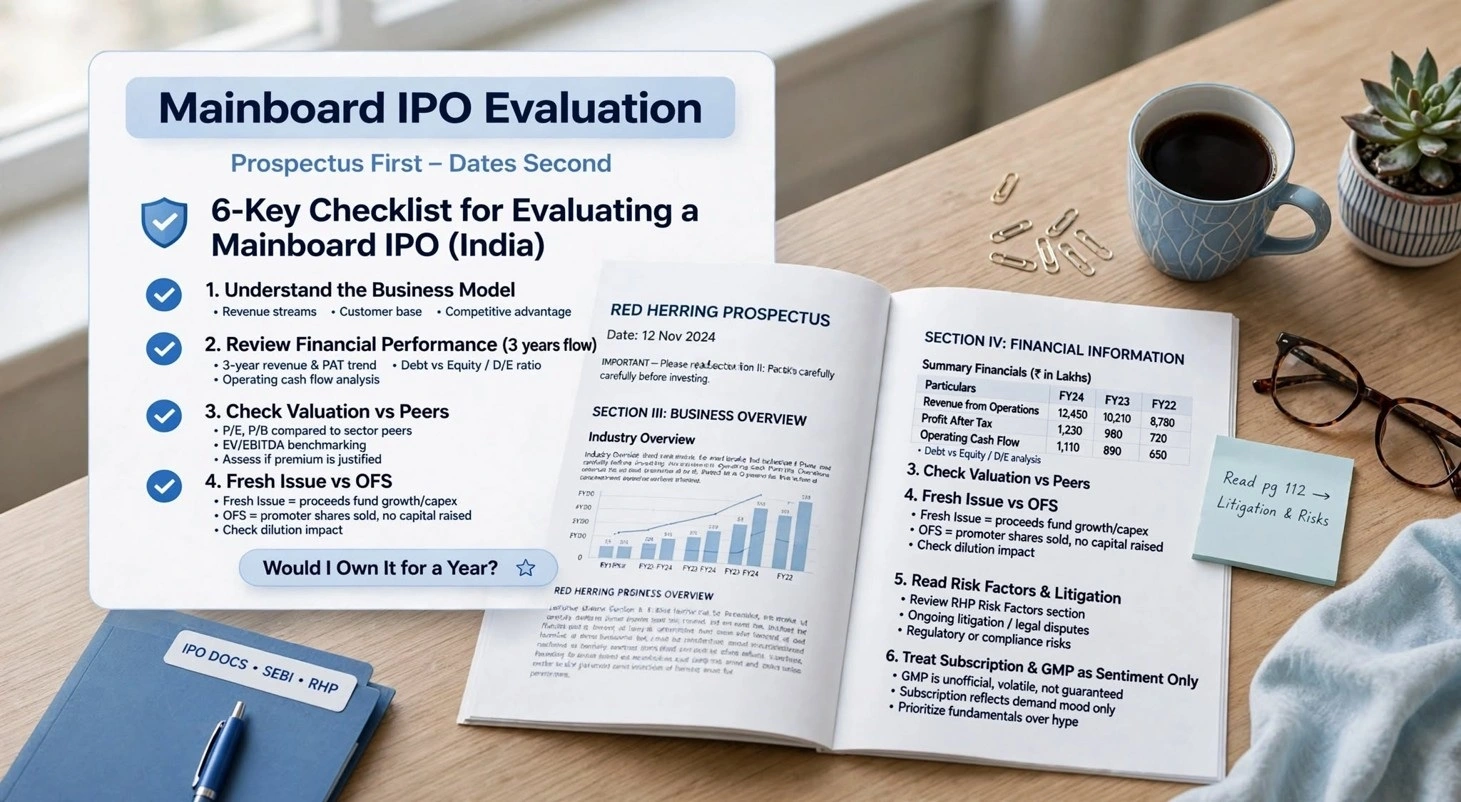
1. Understand the Company’s Business Model
Try to finish this sentence: “Customers pay this company for ___, and they will keep paying because ___.” If you don’t know why customers would keep paying, you should read more about the business. If the answer still isn’t clear, skip that IPO.
Then look for fragility. How much revenue comes from the top five customers? Does the business depend on a licence or a government-set price? What could a larger rival do to it in two years? The industry chapter is usually based on a report the company commissioned, so take the market size from it and form your own view of the outlook.
2. Review Financial Performance
The RHP gives restated numbers for three years plus a recent stub period. Read them side by side, not one at a time.
For example: A company that grew “8%” for two years before jumping to “45%” in the third year.
- What exactly happened then?
- Did the business get a big order, change its accounting method, or actually grow faster.
Check the profit margins at first.
Then compare profit with cash. For example: a company reports profits of ₹60 crore, ₹80 crore and ₹105 crore, but operating cash flow of ₹8 crore, ₹3 crore and ₹15 crore – just a hypothetical figure.
Something is absorbing the cash, usually unpaid customer dues or inventory. It may all be collectible, but the prospectus should explain why it has not been collected in three years.
3. Check the IPO Valuation
A good business can still be a poor purchase. Calculate the market capitalisation at the upper end of the price band and look at the P/E the RHP discloses. For banks and NBFCs, price-to-book is usually more useful. For companies that still lose money, price-to-sales or “EV/EBITDA” is a more sensible option to look for.
Build your own peer list, because issuers choose comparisons that flatter them. As an illustration, suppose the upper band is ₹320 and earnings per share is ₹8, giving a P/E of 40, while three similar listed companies trade at 26 to 30 times. You would be paying roughly a third more. That can be justified if growth is clearly faster or returns on capital are clearly better. If the numbers look like the peers’, the premium is just the IPO label.
4. Understand Fresh Issue vs Offer for Sale
In a fresh issue, new shares are created and the money goes into the company. In an offer for sale (OFS), existing shareholders sell and the money goes to them.
Picture two ₹1,500 crore issues. In one, ₹1,200 crore funds two new plants. In the other, ₹1,200 crore is a private equity fund selling after nine years. Both are legal and either can work out, but you would be buying for very different reasons. Read the “Objects of the Issue” section. Specific plans, with a location, capacity and timeline, are easier to trust than “general corporate purposes,” which SEBI caps as a share of the fresh issue.
5. Read the DRHP and RHP
You do not need all 400 pages. Concentrate on the risk factors (the first ten matter most), the litigation tables, promoter shareholding before and after the issue, any pledged shares, related-party transactions, and the auditor’s remarks. If one of these troubles you, that is reason enough to skip. Another issue will come along.
6. Examine Subscription Data and GMP Carefully
Subscription figures show who is bidding. Qualified institutional buyers tend to bid on the final day, so a quiet first day means little. Non-institutional investors bid late and in large blocks, which can swing the headline number. Retail investors can bid up to ₹2 lakh per application. In many book-built issues from profitable companies the offer is split roughly 50% for QIBs, 15% for NIIs and 35% for retail, but the RHP gives the actual allocation.
An issue subscribed 80 times shows demand, not that the price is fair. Several “heavily oversubscribed” IPOs have either listed flat or lower.
Grey market premium — GMP — is the unofficial amount over the issue price at which shares trade informally before listing. SEBI and the exchanges do not regulate it, figures differ between websites, and it can move within hours. It describes this week’s mood. It says nothing about debt, cash flow or promoter conduct, and neither GMP nor subscription guarantees a listing gain.
Important IPO Dates and Details to Track
Once an issue passes your checks, note these details:
- Opening and closing dates, which define your bidding window
- Price band and lot size, to work out the amount per application
- Issue size, and the fresh issue/OFS split
- Allotment date, usually the first working day after close
- Refund and demat credit, typically two working days after close
- Expected listing date, three working days after close
Confirm each against the RHP and exchange notice, since terms do get revised.
Common Mistakes IPO Investors Should Avoid
Applying because an issue is popular. A lot of people applying doesn’t mean the shares are worth asking the price.
Ignoring valuation and company risks. The company and the IPO are separate decisions, and the price decides which one you own.
Treating GMP as a guaranteed return. It is a rumour with a number attached.
Relying on social media tips. If a Reel or a Telegram post is your only source, ask who benefits from your application.
Investing money you need soon. If the money is for fees or rent within a year, shares are the wrong place for it, however good the issue looks.
How to Compare Mainboard IPO Opportunities
If a few IPOs open at the same time, you don’t have to apply for every one. First of all, do your research, and pick the one or two you understand best, and put them side by side on a single page with the same lines for each: how it earns, three-year profit and cash flow, P/E against peers, fresh issue versus OFS, and your biggest concern.
Before you decide, investors can review and compare mainboard IPOs alongside their offer documents, financial results, valuation and stated use of funds, and Malik Times keeps current issues listed with their key terms for that comparison. The issue that still looks good on your one-page sheet is the one worth bidding for.
A Practical IPO Evaluation Checklist
- I can explain the business and its revenue sources in two sentences.
- Financial statements and debt look sound over three years, including operating cash flow.
- Valuation holds up against relevant listed peers.
- I have read the DRHP or RHP, especially risk factors and litigation.
- I know how the proceeds will be used, and who is selling in any OFS.
- I have considered the risks and my investment time horizon.
- I am not assuming listing gains are guaranteed.
If you cannot tick most of these, skip the issue.
Conclusion
Overall, tracking upcoming IPO is only the first step. Most importantly, you also need to understand the company behind the ticker — how it earns money, what it spends, who is selling, and what could go wrong.
Before applying, ask yourself one question: would I still want to own this company’s shares if the price didn’t go up for a year? If yes, you may have a reason to invest. But, if the answer depends on a listing-day jump, you are guessing.
Disclaimer: Remember that this article is solely for educational purposes only and should not be taken as investment advice. For that, please consult a SEBI-registered investment adviser and check the latest rules and figures from “SEBI, NSE, BSE” and each issue’s official documents.