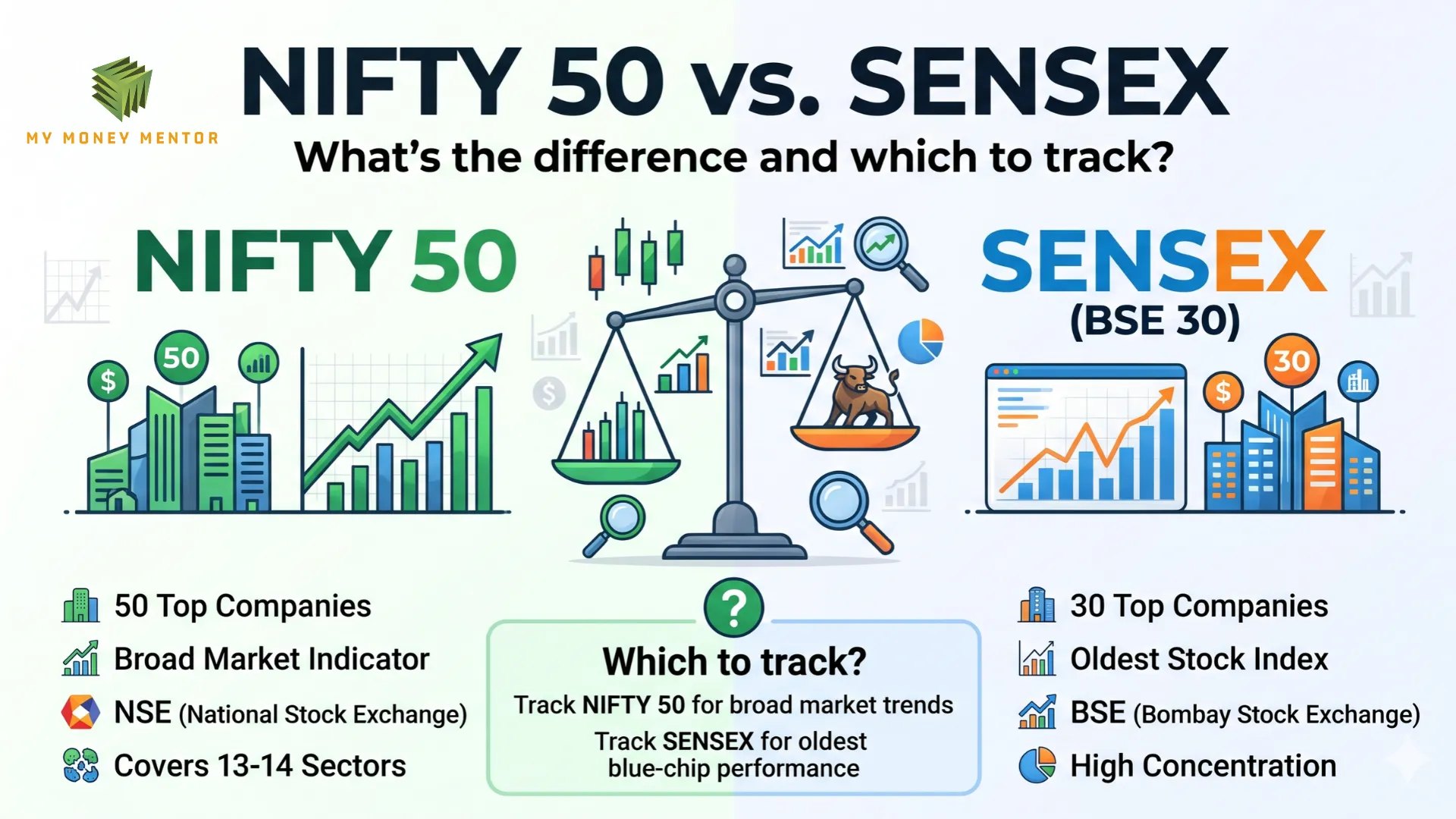

When you visit any financial news website or the stock market on your phone, you will notice that there are two terms which keep repeating – Nifty 50 and Sensex. While both of them give an indication about the performance of large companies in India, both indices comprise different firms and are managed by different stock exchanges.
Knowing the Nifty 50 and Sensex Difference is quite essential for beginners because both these indices will help you understand the movements in the market, make comparisons and assess the performance of your mutual funds. But neither of these indices can tell you about the performance of each and every stock in the market.
Quick Answer:
Nifty 50 tracks 50 leading companies listed on the NSE, while Sensex tracks 30 leading companies listed on the BSE. Both indices measure the performance of large Indian companies and help investors understand overall market trends, but their different constituents and weightings can lead to slightly different movements and returns.
Key Takeaways
- While Nifty 50 covers 50 large companies listed on the NSE, Sensex covers 30 leading companies listed on the BSE. The calculation method used for both indices is free-float market capitalisation.
- New traders could watch both indices for an overview of market direction. Mutual fund traders need to focus on the benchmark, while index fund traders need to consider the expense ratio, tracking error, and total return before trading.
- One must compare percentage returns over the same period rather than point levels in the index. Note that both indices involve market risk and cannot provide future returns.
What is a Stock Market Index?
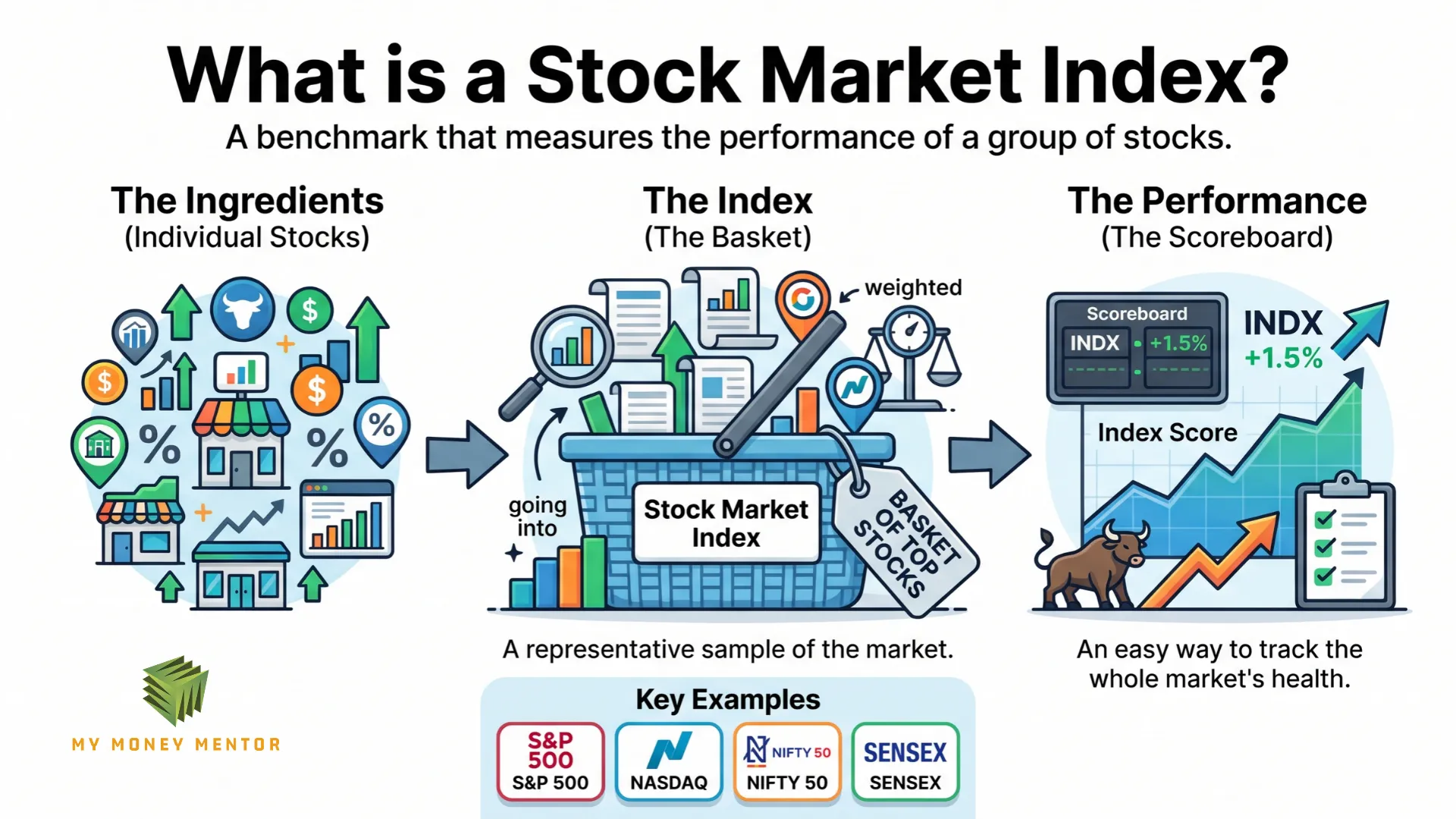
A stock market index is a way to measure the performance of a specific set of stocks. It can be compared to a report card that shows the performance of a selected group of firms.
Consider an example where there are 50 students in a school. Instead of finding out the grades of each student individually, we find out their average performance level. Similarly, a stock market index is used, but instead of taking averages, weightages are used in calculating the index value.
If the companies that make up the index perform well, the index would rise. If they do not, then it would decline.
What is Nifty 50?
Nifty 50 refers to the main stock market index of the National Stock Exchange (NSE). The Nifty 50 comprises 50 companies selected from the most liquid companies in the Indian economy, operating across different economic sectors.
These economic sectors may include banking, information technology, automobiles, energy, pharmaceuticals and consumer goods.
For example, whenever there is high demand for buying the stocks of banks and IT companies in the Nifty 50 stocks, it may lead to an increase in their stock prices and hence lead to the value of the index increasing, provided that the total performance and weightage of all its constituents drive the change in the index.
Uses of Nifty 50 include the following:
- To determine the general trend of the Indian stock market.
- To assess the performance of mutual funds.
- To keep track of index funds and ETFs.
- To trade index derivatives such as futures and options.
The base value of the Nifty 50 is 1,000, calculated from the closing prices on November 3, 1995.
What is Sensex?
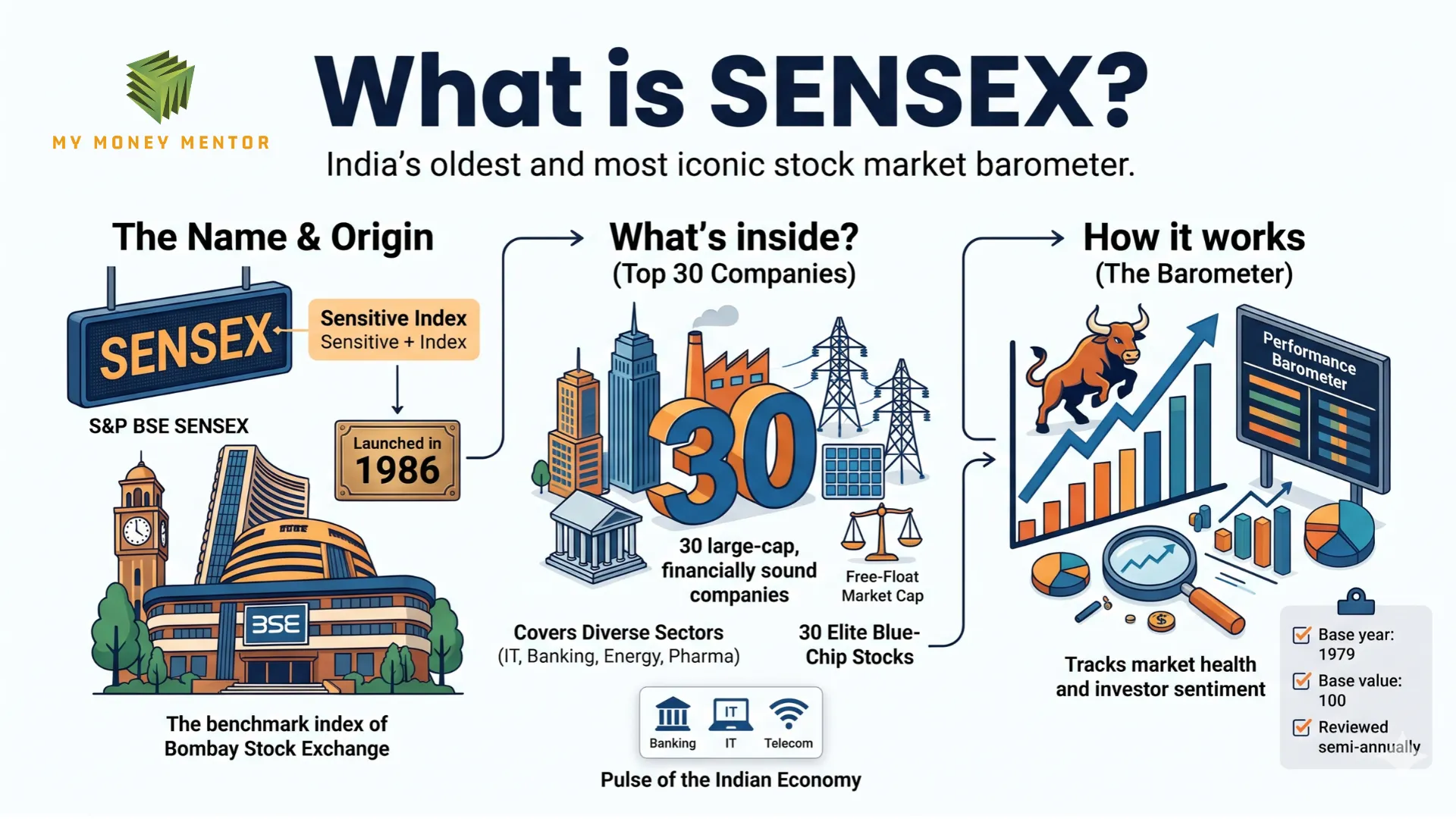
Sensex is the stock market index benchmark of the Bombay Stock Exchange (BSE). It monitors the 30 largest and financially sound companies operating in important sectors of the Indian economy.
Similar to the Nifty 50, the Sensex gives an idea of how leading Indian companies perform. The component stocks come from various sectors; hence, the Sensex is not based on a single company or sector.
Sensex is helpful for:
- Monitoring the performance of top BSE companies.
- Estimating the market sentiment.
- Benchmarking your investment portfolio against it.
- Long-term monitoring of the Indian stock market.
Sensex started operating on January 2, 1986, and has a base value of 100, with the base period of 1978-79.
Nifty 50 vs. Sensex
The most significant difference between Nifty and Sensex is that Nifty comprises more companies than Sensex, depending on the exchanges to which they belong. Nifty 50 comprises 50 companies in the NSE benchmark index, whereas Sensex tracks 30 companies on the BSE exchange.
| Feature | Nifty 50 | Sensex |
| Stock exchange | National Stock Exchange (NSE) | Bombay Stock Exchange (BSE) |
| Number of companies | 50 | 30 |
| Index provider | NSE indices | BSE indices |
| Base value | 1,000 | 100 |
| Base period | November 3, 1995 | 1978-79 |
| Main purpose | Tracks 50 selected large-cap companies | Tracks 30 selected large-cap companies |
| Common uses | Benchmarking, index funds, ETFs, derivatives | Market tracking, benchmarking, index-linked products |
| Market coverage | 65% of the total free-float market capitalisation of all stocks listed on the NSE | 45% of the total free-float market capitalisation of stocks listed on the BSE |
Real Case Study of Nifty 50 Versus Sensex in the COVID-19 Market Crash
March 2020 market crash during the COVID-19 pandemic can be used to conduct a real-life study on the performance of Nifty 50 and Sensex during the same economic shock.
According to the Indian government’s Monthly Economic Report for May 2020, both indices declined sharply in March 2020 due to the impact of COVID-19, which disrupted economic activity and led to uncertainty in financial markets.
In March 2020, the Nifty 50 fell by 23%, and the Sensex also declined significantly. In April 2020, as governments began to announce various stimulus packages, the Nifty 50 was up by 14.7% and the Sensex by 14.4% DEA.
The upward trend continued through the 2020–21 financial year, as seen in SEBI’s Snapshot of the Equity Markets in India, with the Nifty 50 up 70.9% and the Sensex up 68% during FY2020–21.
Conclusion
The Nifty 50 vs. Sensex difference will assist investors in making wise decisions regarding the Indian Stock Market. The Nifty 50 consists of 50 leading stocks from the NSE exchange, whereas Sensex includes 30 leading stocks from the BSE.
Both the Difference between Nifty 50 and Sensex are barometers of the stock market; however, due to differences in their composition and weightage, returns may differ slightly. Examples from history, such as the market crash during the coronavirus pandemic, have shown that both indices can experience sharp declines and recoveries.
FAQs
Q: Can Nifty 50 and Sensex be used to forecast future movements in the stock markets?
Ans: No. Neither index can forecast future market movements. The Nifty 50 and Sensex are trailing indicators that mirror the present and past market value of their constituent firms. While structural chart patterns and historical data points assist technical analysts in evaluating probability distributions, real-time market movements remain dependent on fresh macroeconomic data, corporate earnings prints, global liquidity flows, and monetary policy shifts.
Q: Do the Nifty 50 and Sensex factor in the dividend income while calculating the indices?
Ans: Yes, via specialised variants. The standard price indices displayed on television networks and news tickers are Price Return Indices (PRI), which track only capital gains and exclude dividends. However, both index providers actively maintain a Total Return Index (TRI) variant that assumes all dividend payouts are instantly reinvested back into the index.
Q: Why does Nifty 50 move in the opposite direction to the Sensex?
Ans: Despite the similar movement patterns of the two indices, they may move in opposite directions because they are made up of different stocks and have different weightings for each stock. For instance, gains on high-weighting stocks in one index may compensate for losses somewhere else, while the other may show the opposite trend.

Jyoti Barman is a finance content writer with an MBA in Finance and expertise in stock markets, investing, and personal finance. Drawing on her formal training, she distills complex financial topics into clear, practical guidance. Through her work, she empowers readers to understand their options and make better-informed financial decisions.