

A financial advisor helps individuals plan their finances, assess investment options and work towards goals such as retirement, wealth creation and buying a home. In India, investment advisers registered with the Securities and Exchange Board of India (SEBI) are subject to specific regulatory requirements when providing investment advice on securities.
SEBI’s Investor Survey 2025 found that only 36% of investors had moderate or high knowledge of the securities market, highlighting the importance of informed financial decisions. Asking the right questions before hiring an adviser can help investors assess their qualifications, approach and suitability for their financial needs.
The following questions to ask a financial advisor in India can help investors make a more informed choice before entering into an advisory agreement.
Quick Answer:
A financial advisor helps you make informed financial decisions based on your income, goals, risk tolerance and investment needs. Before hiring one, ask about their SEBI registration, qualifications, services, fees, commissions, conflicts of interest, investment approach and grievance process. Always review the written agreement and verify the advisor’s credentials before proceeding.
Key Takeaways
- SEBI Registered Investment Advisers must follow obligations relating to risk profiling, suitability assessment, conflict disclosure and client protection before providing investment advice. Individual Investment Advisers must move to non-individual registration status if they cross the threshold of 300 clients or ₹3 crore in annual fee collection, as applicable.
- The maximum annual fixed fee for eligible individual and HUF clients is ₹1,51,000 per client family, while the maximum AUA-based fee is 2.5% of Assets Under Advice per annum per client family.
- Before engaging an advisor, investors should confirm their registration, qualifications, services, conflicts of interest, monitoring and reporting processes, termination terms and grievance procedures.
Questions on the Registration, Experience, and Services of the Advisor
1. Are you registered with SEBI as an investment adviser?
This would be one of the first questions to ask a financial advisor in India. An individual providing investment advisory services as a profession in securities must comply with the SEBI regulatory framework applicable to the purpose, unless an exemption exists.
SEBI’s official list enables investors to check an advisor’s registration number, name, address, contact details, and registration status.
The adviser should be able to readily furnish his SEBI registration number. Investors should verify information available on the SEBI website and not rely on certificates, websites, or social media.
According to SEBI’s 2025 guidelines, an individual IA whose client count exceeds 300 at any time during the relevant period, or whose annual fee collection exceeds ₹3 crore, whichever is earlier, must begin transitioning to non-individual registration.
2. Are there any qualifications and certifications available with you and your advisory team?
Enquire regarding the qualifications and certifications that the person offering investment advice possesses in terms of education and experience as well as NISM certifications.
| Areas to ask about | What the investor should verify |
| SEBI registration | Registration number and current status |
| Principal officer | Name and relevant qualifications |
| Advisory team | Qualifications and certifications |
| Experience | Years working in investment advisory |
| Specialisation | Products and financial areas covered |
3. What exactly is included in your advisory service?
Do not expect that by paying the advisory fee you will have access to all financial services. The role of financial advisor in India involves investment planning, portfolio management, mutual fund recommendations, asset allocation, retirement planning, investment tax considerations, insurance investment planning or periodic portfolio evaluation.
The investor needs to know how often the review process takes place and what type of advisory service will be provided. According to SEBI, it is the obligation of an IA to prepare reports for clients regarding current and potential investments.
The description of the service must be contained in the contract. The Investor Charter of SEBI stipulates that the advisory relationship must be governed by a contract that includes elements such as fees, conflicts of interest, and confidentiality.
4. What will be the method to judge the suitability of the investment for me?
According to SEBI, it is necessary to undertake risk profiling to decide on which product would be most suitable. Factors that can go into profiling include income, age, and experience in the securities market. Only then can the IA advise his client on investing.
A proper advisory process thus involves first understanding the investor himself rather than starting the discussion with individual stocks, mutual funds or any other investment.
Ask the advisor whether he intends to evaluate:
- Investment objectives
- Time horizon
- Income and other financial commitments
- Present investments
- Experience in the market
- Loss-bearing capacity
- Risk-taking ability
- Liquidity needs
- Important financial objectives
- Frequency of reviewing and updating the risk profile.
Questions on Fees, Conflict, and Investment Process
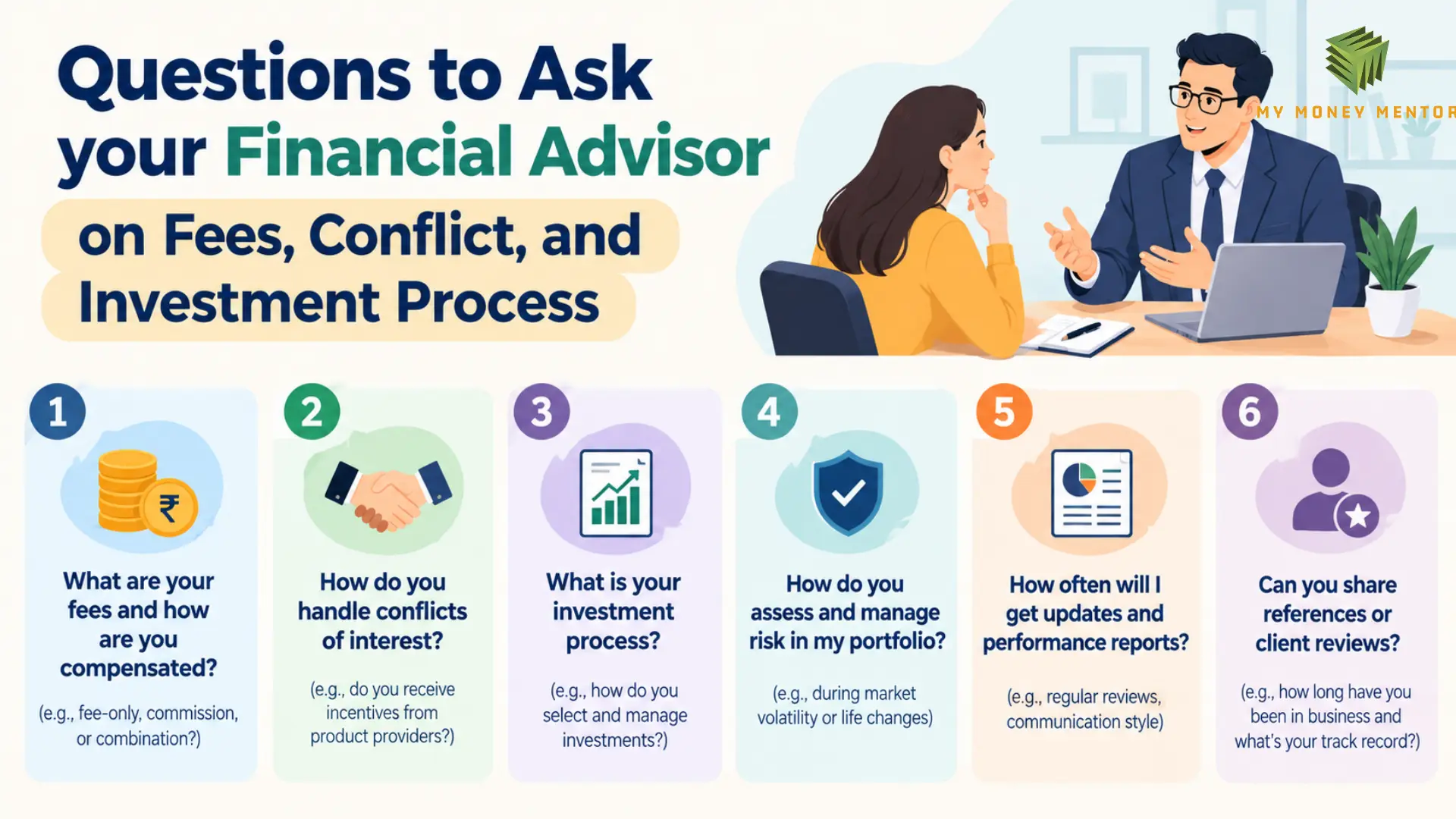
5. What precisely do you charge as your advisory fee?
The fee charging structure must be clarified before engaging an advisor. The investor must inquire if the fee is fixed or based on Assets Under Advice, how often it is charged, if any taxes or statutory fees are included additionally, and what will happen if the advisory agreement terminates before the fee period ends.
As per the prevailing SEBI structure, permissible individual or HUF clients can be charged either a fixed fee or an Assets Under Advice (AUA) fee. The maximum allowable fee under the fixed fee structure is ₹1,51,000 per client family per annum, and under the AUA fee structure, it is 2.5% of AUA per client family per annum.
6. Are you compensated through commissions, referral fees, or other remuneration from investment products?
This is perhaps one of the most critical questions since such compensation can have implications on the economics of the advice.
Ask the advisor to explain in detail all types of remuneration received from the advisory engagement or any related services. Investors need to inquire about whether the advisor or an affiliated person has any distribution, execution, or other financial services activities.
The SEBI guidelines mandate IAs to disclose any conflict of interest and create an arm’s length relationship between advisory activity and other activities. For non-individual IAs, segregation of advisory and distribution activities in relation to clients is another requirement.
In the case of an individual IA, SEBI specifies that the IA shall not provide distribution services to his advisory client, and certain specified family members of the individual IA are also restricted in terms of distribution relationships.
Client Protection, Surveillance, and Termination Issues

7. Who will be given access to my money, my account, or the passwords of my investments?
The advisor may need some information related to finance to give you advice; however, it is equally essential that you know exactly what kind of access is required by the advisor.
Discover if the advisor needs access to your demat account, trading account, bank account, or any online investment portal. Does the advisor have permission to transact on your behalf? According to SEBI regulations, the IA cannot enter into a purchase or sell transaction on your behalf unless your explicit permission has been sought for each transaction.
It is important for investors to distinguish between advice and the act of transacting. The advisory relationship should not necessarily grant the advisor unrestricted control over the investor’s finances.
8. What if I do not want the advisory service anymore?
It is always wise to know the termination procedure before signing any agreement. The client needs to know the notice period, method of termination, refund policy, and other obligations, if any, along with the availability of the past reports.
The current SEBI regulatory provision allows payment of advance fees, if agreed by the client, within the prescribed advance period. In case of premature termination of the advisory service, then the client is eligible for a proportionate refund of the advance amount. These details should be included in the advisory agreement.
9. What if I need to file a complaint?
The SEBI Investor Charter mandates that IAs give investors information related to the grievance process. The IAs also have to display the process to file a complaint and investor complaints on their website or mobile application.
In case you cannot resolve your issue via the complaint process followed by the advisor, then you may use the SCORES portal provided by SEBI. SCORES is the online centralised grievance redress mechanism through which you can file your complaints against IAs.
Before selecting an advisor, ask them for their grievance procedure and the name of their compliance officer/person-in-charge.
10. Will all our agreements be put down in writing?
An agreement in writing is an essential part of the advisory relationship. Clients should not make their decisions based only on verbal agreements concerning fees, services, portfolio review, conflicts, refunds, and investment recommendations.
According to SEBI’s Investor Charter, the IA should enter into an agreement with the client that includes all relevant information, such as fee information, conflict-of-interest disclosures, and confidentiality clauses.
Make sure to review before you sign:
- Services covered
- Advisory fee
- Method of calculating the fee
- Billing schedule
- Taxes and other charges applicable
- Conflict-of-interest disclosures
- Confidentiality clause
- Termination provisions
- Refund provisions
- Reporting procedure
- Grievance redressal mechanism
Conclusion
Choosing a financial advisor requires more than checking their reputation or past performance. The questions to ask a financial advisor in India should cover registration, qualifications, fees, conflicts of interest, investment suitability and client protection. Investors should also understand how the adviser communicates recommendations, responds to changing financial circumstances and supports long-term planning.
Taking time to assess these factors can help investors establish clear expectations and make informed decisions about their finances. Reviewing the adviser’s credentials and written agreement before committing can also reduce the risk of misunderstandings later.
FAQs
Q: What is the difference between a financial advisor and a mutual fund distributor?
Ans: A financial advisor provides financial or investment recommendations within their authorised scope, while a mutual fund distributor facilitates fund investments and may earn commissions.
Q: What should I do if an investment recommended by my advisor incurs a loss?
Ans: Review the recommendation, disclosed risks and advisory agreement. If you suspect misconduct, raise a complaint through the adviser’s grievance process or applicable SEBI channels.
Q: Can I get financial advice online in India?
Ans: Yes, financial advice is available through online consultations and digital platforms. Verify the professional’s credentials, applicable registration and data protection practices before proceeding.