

Summary
- Government securities, or G-Secs, are tradable debt instruments issued by the Central or State Governments.
- G-secs can be categorised into treasury bills, cash management bills, dated securities and state development loans.
Government Security, also known as G-Sec, is an investment instrument issued by the state or central government to raise funds for infrastructure and development projects, in exchange for regular interest and repayment of the face value after maturity.
For coupon-bearing securities, interest is calculated on the face value at the coupon rate specified in the security’s terms. Since these investment instruments are backed by the government, the associated risk is comparatively low. Government bonds also guarantee the repayment of the principal amount invested to the bondholder upon maturity.
Suppose an investor buys a six-year Government of India security with a face value of ₹50,000 and a coupon rate of 5% per year at its face value.
The annual interest is ₹2,500, generally paid as two half-yearly payments of ₹1,250. Over six years, the investor receives ₹15,000 in total coupon payments. At maturity, the ₹50,000 face value is repaid.
Therefore, the investor’s total cash receipts are ₹65,000, comprising ₹15,000 of interest and the return of ₹50,000 principal. This calculation excludes tax and assumes the bond is held until maturity.
Types of Government Security
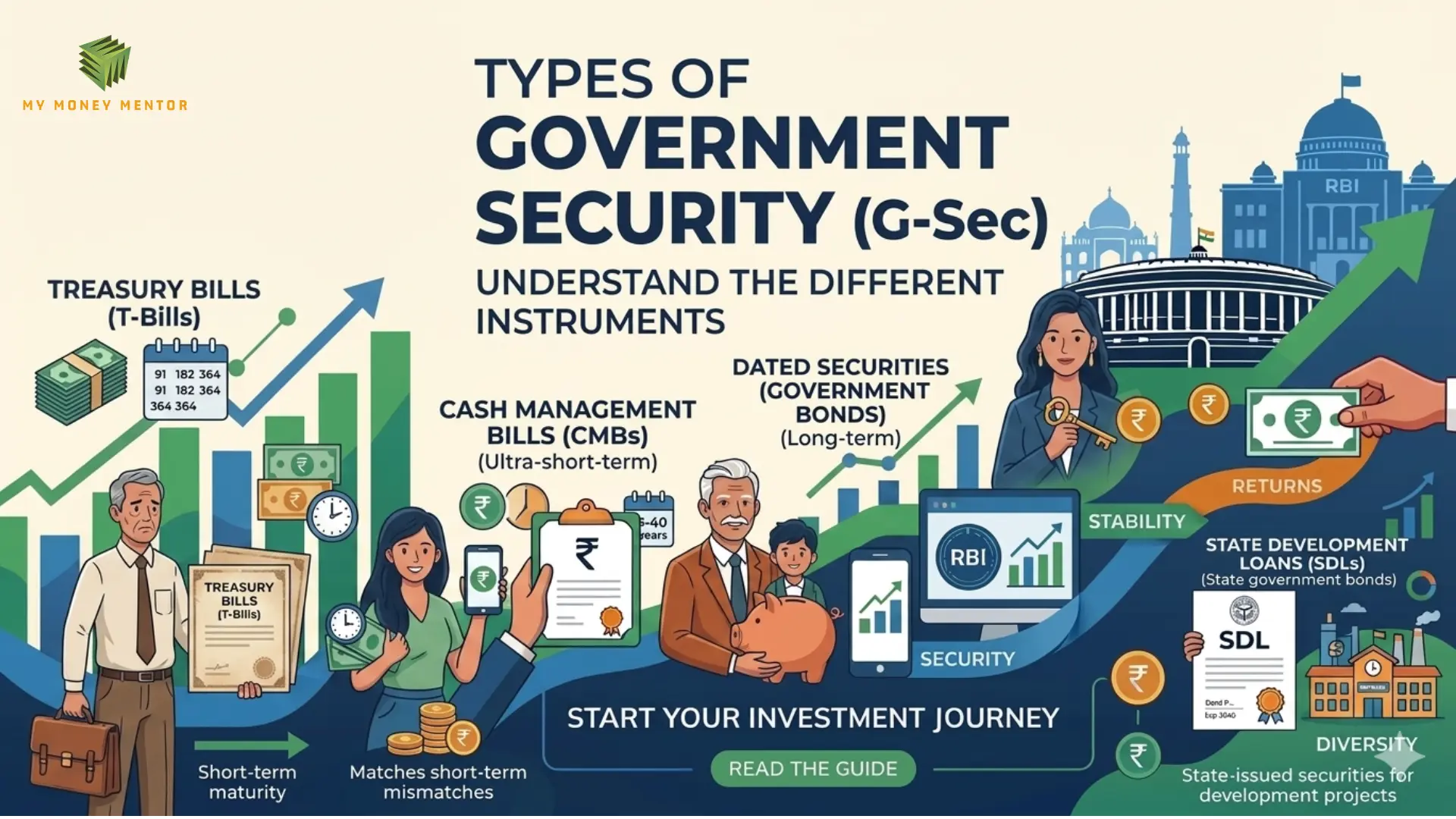
G-Secs can be short-term and long-term securities. Short-term securities include Treasury Bills (T-Bills), and long-term securities include Government Bonds or Dated securities. In India, the Central and State governments issue securities to fulfil their requirements.
- Treasury Bills or T-Bills: The Treasury bills are the securities issued by the Government of India for a fixed tenure. The tenure of a bill can vary between 91 days, 182 days and 364 days. There is no payment of interest. Instead, the price is discounted at the time of issue and at the end of the tenure, the initial investment is redeemed at face value, i.e., the actual value of the bill. Suppose a T-Bill with a face value of ₹10,000 is purchased for ₹9,800. On maturity, the investor receives ₹10,000. The ₹200 difference is the return before tax.Therefore, the difference between the issue price and the face value is the return on investment.
- Cash management Bills or CMBs: The CMBs are issued by the Government of India to bridge temporary gaps in cash flow requirements. They are similar to T-Bills but are issued for a period less than 91 days.
- Dated Securities or Government Bonds: Dated securities are securities issued by the Government of India in exchange for interest paid on the face value of the security, where the interest is calculated on a half-yearly basis. The bond can be a fixed-rate bond or floating-rate bond. The fixed-rate bond refers to a fixed rate of interest till maturity, whereas the floating-rate bond means that the rate can be changed at intervals of either 6 months or 1 year.
- State Development Loans (SDLs): State Development Loans are dated securities issued by State Governments to meet their borrowing requirements. They generally pay interest every six months and repay the face value at maturity. RBI conducts SDL auctions on behalf of the respective State Governments.
How to Buy and Sell G-Secs
G-Secs can trade through several platforms.
- RBI Direct: NDS-OM is an electronic system that allows direct trading of government securities. Here, securities can be bought and sold by considering the different prices offered. The RBI introduced this system.
- Stock Exchanges: The Stock Exchange market allows access to buying or selling government securities after creating a Demat and Trading account.
- Financial Institutions and Banks: Banks and Financial Institutions also facilitate over-the-counter trading in Government securities either directly or through a broker.
Now let’s see how G-Secs actually work.
Step 1: Choose the platform: The first step of trading in Government securities is choosing a platform for trading. You can choose from trading through NDS-OM, or a financial institution or a broker. If you are deciding to trade through the stock exchange, it is preferred to open your Demat and Trading account as per the requirements.
Step 2: Choose the instrument: After choosing the platform, choose the instrument or tool you would like to invest in. It can be T-Bills, dated securities or SDLs. If your goal is to invest for a longer period, you can choose between dated securities or SDLs. And If you are after fast returns, i.e., within a few days or months, then it is preferred to choose T-Bills or CMBs.
Step 3: Analyse the market: Next, analyse the security you chose to invest in the primary and the secondary market. The primary market is where new government securities are issued, whereas the secondary market includes trading, i.e., buying and selling of existing securities at market value. Also consider factors like issue price, face value, returns, maturity period, etc.
Step 4: Start trading: Once you have selected the security that suits your goal, invest in it and enjoy the returns. If you want to sell your holding before maturity, you may sell it in the secondary market at the market value at that time.
Government Securities vs other instruments
| Basis | G-Sec | Fixed Deposit | Stock |
| Issued by | Central or State Government | Banks and Financial Institutions | Company |
| Level of Risk | Comparatively Low | Low | High |
| Returns | Fixed | Fixed | variable |
| Tenure | Long-term as well as short-term | Long-term | No fixed tenure |
| Income | Regular interest income | Fixed interest | Dividends |
Benefits of Government Securities
- Safe Instrument: Government security is said to be comparatively safer than other instruments, as they are backed by the government and have lesser chance of default.
- Guaranteed return: They provide a predictable cash flow as long as the investment period is not over.
- Diversify your portfolio: Investing in government securities with other market securities will maintain a balance as government securities carry relatively less risk than others securities.
Common Mistakes to Avoid
- No Financial Goal: Some investors do not consider their financial goals and invest in securities which may make it tricky for them to understand the risk measurements.
- Ignoring RBI Policies: Decisions made by the RBI have a direct influence on the securities. So if you choose to ignore any policy while investing, you might have to go through the consequences.
- Temporary Market Movement: As an investor, you should be aware of short-term market movements and avoid making any strong decisions influenced by any temporary fluctuation of market value.
- Avoiding Inflation Risk: Although Government securities are backed by guaranteed returns, they may not always benefit you. Sometimes, the inflation rate can reduce the return value of the security over time.
Final Thoughts
Government Securities or G-Secs are the fundraising securities issued by the government for several development projects. They are considered safer than other financial instruments in the market because they are backed by the Government of India. From short-term tools such as Treasury Bills to long-term tools such as State Development Loans and Dated securities, Government securities offer a range of options to choose from.
Although G-Secs are considered safe, they still require a proper understanding of the factors that influence the returns over time, such as inflation risk, RBI policies, etc. Therefore, as a beginner, you must understand and analyse the instruments and securities according to your goals and the risk involved.