


Summary
- Capital gains refers to the profit earned after transferring or selling an investment security.
- Capital gains are classified into Short-term and Long-term Capital Gains, including different tax rates and exemption provisions.
When you sell an investment security such as property, equity shares, gold, mutual fund units, and bonds, and walk away with more money than you put in, that profit is called a capital gain. The Income Tax Act, specifically Section 67, formerly Section 45 of the Income Tax Act, 1961, requires you to declare and pay tax on this gain.
Not every sale results in a taxable gain. If an investment security is sold at a loss, it creates a capital loss, which may be adjusted against eligible gains subject to the provisions of the Income Tax Act. The amount of tax payable on these gains depends on one important factor, i.e., the time period for which the investment was held before being sold.
What are Short-Term Capital Gains?
The profit earned from selling an asset security is sold before the prescribed holding period prescribed under the Income Tax Act, are classified as Short-term Capital Gains. The profit falls under the short-term category and is taxed accordingly as the investments are held for a relatively shorter duration,
The holding period differs across different securities. Some common examples of transactions that may generate STCG include the following.
| Category | Duration to qualify for STCG(Less than) |
| Equity Mutual Funds | 12 month |
| Specified Mutual Funds | 24 months (purchased on or after April 1,2023) |
| Real Estate, Gold | 24 months |
| Unlisted Shares | 24 months |
| Listed Shares | 12 months |
Eligible tax rates for STCG are given below.
- The tax rate on listed shares and equity mutual funds has increased from 15% to flat 20% (Section 196) after 23rd July 2024, when the Securities Transaction Tax is paid.
- For other assets, such as property, gold, and debt funds, are added to total income and taxed based on income tax slab, applicable to you.
Gains from unlisted bonds and unlisted debentures transferred, redeemed or matured on or after 23 July 2024 are deemed to be STCG regardless of the holding period.
Listed bonds can qualify as long-term after more than 12 months and are generally taxed at 12.5% without indexation.
What are Long-Term Capital Gains?
Under Section 197, once you’ve held an investment long enough to exceed the prescribed holding period, any gain on its sale becomes a long-term capital gain and generally attracts a lower tax rate than STCG. Long-Term Capital Gains (LTCG) refer to gains after sale of a capital asset after they have been held for more than the prescribed period.
The holding period for some common securities to generate LTCG is given below.
| Category | Duration to qualify for LTCG (More than) |
| Equity Mutual Funds | 12 months |
| Specified Mutual Funds | 24 months (purchased on or before April 1, 2023) |
| Real Estate | 24 months |
| Listed Shares | 12 months |
| Unlisted Shares, Gold | 24 months |
The 12.5% tax rate on long-term capital gains from securities is not conditional on the acquisition date. Investments made on either side of the 23rd July 2024 threshold are treated identically when it comes to the rate at which gains are taxed upon sale.
Key Differences between Short-term and Long-term Capital Gains
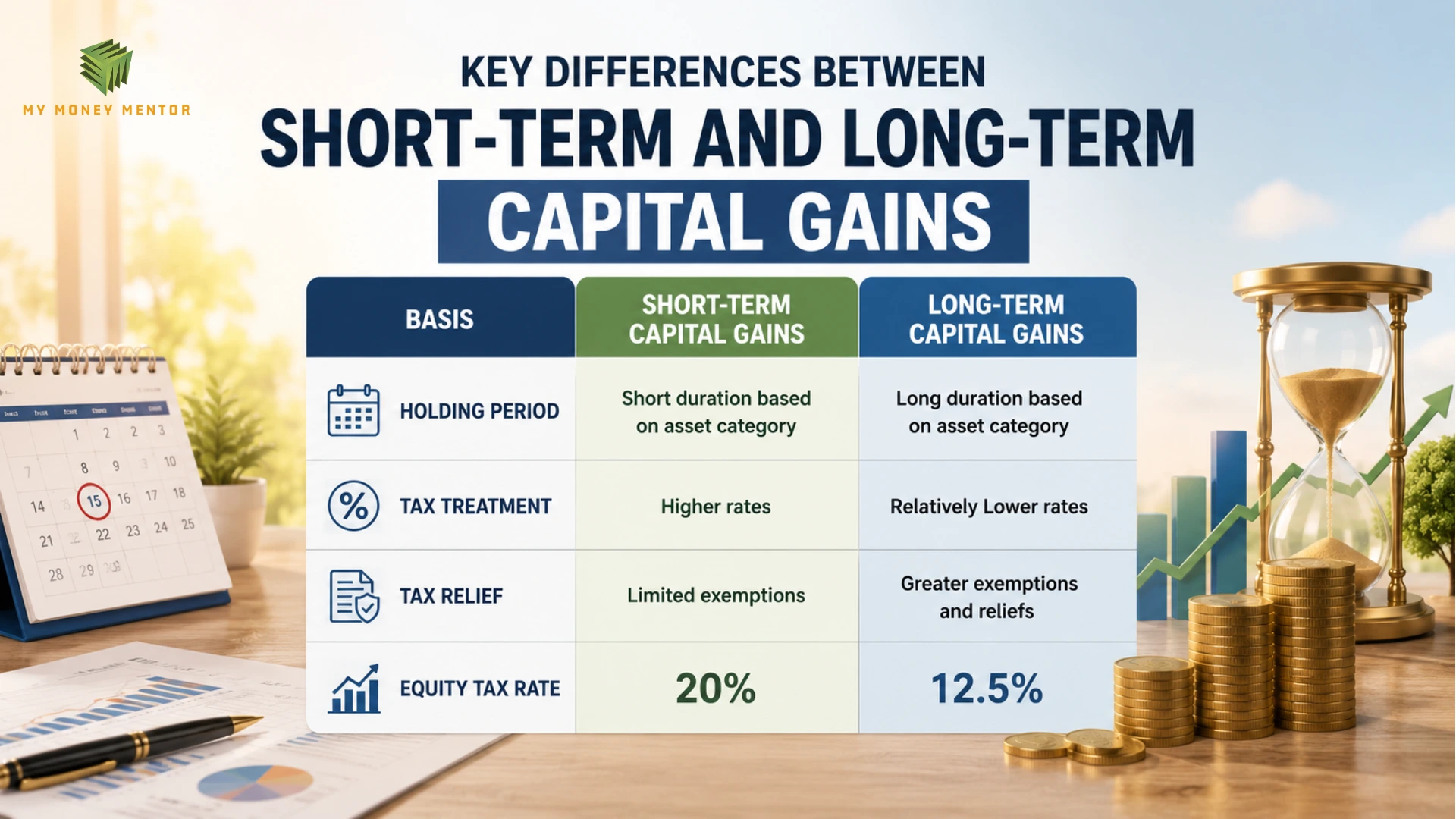
A comparative overview of distinguishing short-term gains from their long-term counterparts.
| Basis | STCG | LTCG |
| Holding period | Short duration based on asset category | Long duration based on asset category |
| Tax treatment | Higher rates | Relatively Lower rates |
| Tax relief | Limited exemptions | Greater exemptions and reliefs |
| Equity tax rate | 20% | 12.5% |
How is Capital Gain Calculated?
Below is the formula for calculating Capital Gain.
Capital Gain = Total Sale value – (Transfer cost + Acquisition cost + Improvement cost)
Once the taxable gain is generated, the applicable STCG or LTCG tax rate is applied.
Let’s understand with the help of an example.
Consider you made an investment of ₹3,00,000 in equity mutual funds in March 2023, and subsequently redeemed in May 2025 at ₹4,80,000. Since the securities were held for more than 12 months, the gains from this transaction are classified as long-term and taxed at 12.5% under Section 198.
For this specific transaction, the total gain is calculated at ₹1,80,000, representing the difference between your redemption value and the initial outlay. By utilising the annual LTCG exemption of ₹1,25,000, your taxable profit is effectively lowered to ₹55,000. Applying the 12.5% tax rate results in an estimated liability of ₹6,875 tax before cess.
| Particulars | Details |
| Investment Amount | ₹3,00,000 |
| Investment Date | March 2023 |
| Redemption Date | May 2025 |
| Hold Period | More than 12 months |
| Redemption Value | ₹4,80,000 |
| Long-term Capital Gain | ₹1,80,000 |
| Annual LTCG exemption | ₹1,25,000 |
| Taxable LTCG | ₹55,000 |
| LTCG Tax Rate | 12.5% |
| Tax Payable (before cess) | ₹6,875 |
Exemptions under the Income Tax Act
The Income Tax Act provides certain capital gain tax exemptions that allow taxpayers to legally lower their tax liability, which are subject to certain conditions and timelines.
- Section 82: Reinvestment in Residential House Property
Reinvesting gains generated from qualified long-term residential property transactions into another qualifying residential property. The eligible exemption is restricted to whichever of the following amounts is lower, i.e., ₹10 crore or the accumulated amount invested in an eligible residential property alongside any amount deposited under the Capital Gains Account Scheme (CGAS).
- Section 83: For Agricultural land
The land that has been used for farming purposes for a minimum 2 years. The exemption is limited to the total amount invested in applicable agricultural land together with any amount deposited under the CGAS.
- Section 84: Shifting land or building
Establishing or shifting new buildings or land for the upcoming industrial set-up. The exemption is based on the amount invested in establishing or shifting new buildings or land for the upcoming industrial set-up, deposited under the CGAS.
Common Mistakes Investors Make
Procedural oversights, incorrect exemptions, and misunderstood holding periods remain among the most common errors in capital gains tax filing.
- Miscalculating the holding period: It is quite common to make this error, especially with multiple investment securities. All the acquisitions have their own holding duration. Therefore, assuming every unit under one holding period will impact your filing.
- Ignoring significant expenses: There are certain expenses that can be applied and reduce the taxable amount. Many individuals may ignore certain transaction-related expenses, leading to incorrect taxable amounts.
- Missing reinvestment deadlines: Missing deadlines for reinvestment-based exemptions will impact the exemption qualification. A delay of even a single day results in ineligibility for exemption.
Conclusion
Capital gains tax in India does not represent a one-size-fits-all policy. It depends on the investment type, holding duration, and the tax regime you would opt for. The new Budget 2024 changes, particularly the removal of indexation, the revised rates, and the simplified duration framework, have changed the computation for many investors.
The difference between short-term and long-term capital gains allows investors to understand the various tax rates and exemptions provided by the Income Tax Act of India based on different investment securities. This helps investors to make informed decisions, optimise tax, and take advantage of exemptions. Whether you are seeking quick opportunities or creating long-term wealth, including tax planning in your investment strategy can significantly improve your overall outcomes.
FAQs
What are the types of Capital Gains Tax?
The Capital Gains are classified into two categories: Short-Term Capital Gains and Long-Term Capital Gains.
What are the current tax rates for Capital Gains?
For equity and equity mutual funds: STCG is taxed at 20% (Section 196), and LTCG above ₹1.25 lakh is taxed at 12.5% (Section 198). For other assets such as real estate, gold, and debt instruments, STCG is added to your income and taxed at your applicable slab rate, while LTCG is taxed at 12.5% without indexation under Section 112.
Are gifts and inherited assets taxable?
Receiving a gift or inheritance is not taxed as capital gains at the time of receipt. However, a gift may be taxable under income from other sources unless an exemption applies.
How can I save or reduce Capital Gains Tax?
You can save or significantly reduce Capital Gains Tax by holding investments longer, utilising annual profit exemptions, or reinvesting proceeds into tax-advantaged assets like government bonds or property.
Can capital losses be offset against capital gains?
Yes, with conditions. Short-term capital losses (STCL) can be set off against both STCG and LTCG in the same year. Long-term capital losses (LTCL) can only be used against LTCG. Any unabsorbed losses can be carried forward for up to 8 consecutive financial years, provided you’ve filed your ITR within the due date for the year the loss was incurred.