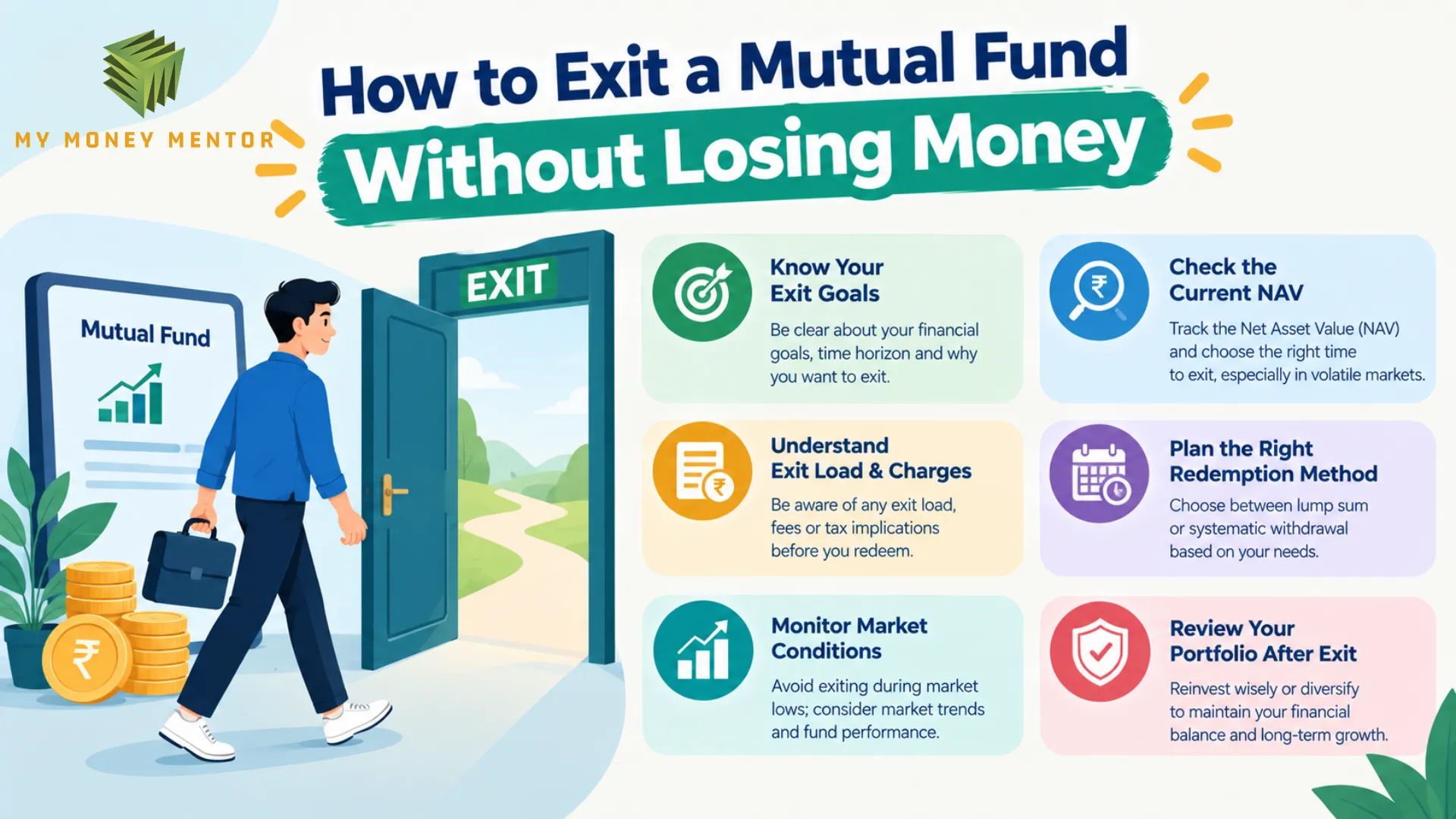


As the Indian mutual fund industry touches a massive milestone of ₹82.64 Lakh Crore in Assets Under Management (AUM), millions of retail investors are actively pooling and pulling capital. However, exiting a mutual fund at the wrong time can quietly erode your hard-earned profits through avoidable friction costs. It is important for the investor to understand the mutual fund exit strategy. Investors must take into account various factors, such as exit loads, taxation, market conditions, and the investment period, before redeeming their units.
Certain mutual fund schemes have a 1% exit load if units are withdrawn within a specified period, whereas taxation may vary depending on the fund’s nature and the investment’s holding period. Knowing how to exit mutual Funds in India can help investors make informed decisions about their redemptions and avoid unnecessary losses.
Quick Answer:
A good mutual fund exit strategy involves checking the applicable exit load, capital gains tax and investment holding period before redeeming your units. Consider partial withdrawals, SWP or STP when suitable, and avoid exiting solely due to short-term market fluctuations. Plan your redemption around your financial goals to minimise avoidable costs.
Key Takeaways
- When exiting a mutual fund, there are important factors to consider, like the investment objective, the type of redemption to choose, the NAV, and the exit load, which is 1% till 1 year and nil after 1 year, depending on the scheme.
- The investor can use SWP to withdraw money from their mutual funds at specific intervals, or use STP to transfer investments between schemes.
- Taxes depend on the fund type and the investor’s holding period. In equity funds, investors pay 20% on short-term capital gains with no gain limit, and 12.5% on long-term capital gains, when gains exceed ₹1.25 lakh.
Key Steps Before Exiting a Mutual Fund Investment
Redemption of mutual funds is not just about clicking “redeem.” There are several things to keep in mind when withdrawing from mutual funds, including the redemption process, the fees involved, and the impact on your tax and investment plans. Here are some good tips to keep in mind.
Step 1: Determine the reason behind the redemption
First of all, try to determine the reason behind selling your mutual fund units. You might have an emergency expenditure, you may want to change your investments to another scheme, or the fund might not be performing very well. But exiting will mainly depend on the type of mutual fund.
Open-ended mutual funds offer liquidity; investors will get their amount credited to their bank account within T+1 days, depending on the fund type.
Step 2: Decide whether full or partial redemption is better
Once the investor decides to exit a mutual fund, make sure you know whether it’s a full or partial withdrawal. Partial withdrawal is advantageous when you need money but still want to stay invested in the portfolio.
The other case would be where you require a full withdrawal. This could be because the investment no longer meets your investment objective, and you require all the money in the account.
| Situation | Better option | What we suggest |
| You need only a small amount for an emergency | Partial redemption | Withdraw only what you need and keep the remaining investments invested, if the fund still suits your goals |
| You need the entire investment for a major financial goal | Full redemption | Consider redeeming the required amount if the goal is due and the money is needed |
| The fund is performing poorly for a major period | Full redemption | Review the fund against its benchmark and category. If it consistently remains unstable, consider exiting |
| The fund has temporarily fallen because of market volatility | Partial or no redemption | Avoid selling only because of short-term market movements, if your long-term goal and risk profile remain unchanged |
| You want to move to another mutual fund | Depends | Compare both funds first. A complete switch may be appropriate if the existing fund no longer aligns with your objectives, but check taxes and the exit load. |
| You need money, but the fund has an applicable exit load | Partial redemption or wait | If the expense is avoidable and the withdrawal is not urgent, check whether it is practical to wait until the exit-load period ends, as after a 1-year holding period, there is no exit load in a mutual fund. |
Step 3: Look for the exit load in mutual fund
The exit load calculation in mutual funds does not apply to all transactions; it depends on the scheme’s specific terms. 1% exit load on the applicable NAV for redemptions made within 1 year of allotment, with no exit load for mutual funds after 1 year.
In such a case, when the applicable NAV is ₹12 and the exit load is 1%, then the redemption price will be ₹12 × (1 − 1%) = ₹11.88 per unit. Similarly, if the units are redeemed after 1 year, the exit load is 0, and the redemption price is ₹12 per unit.
NAV = (Total Assets – Total Liabilities)/ Total Number of Outstanding Units
Step 4: Submit the redemption request through the right channel and ensure the payment
As soon as you determine the amount and time of the redemption, you will need to submit a redemption request via the AMC, the registered mutual fund website, or another authorised channel through which your investment was made. Make sure that the right type of redemption has been selected, that is, whether you wish to redeem the specified amount of money or the units.
If your investment amount is ₹3 lakh and you wish to redeem only ₹1 lakh, be very careful not to select the full redemption option by mistake; instead, select the partial redemption option. The transaction statement should be kept after submitting the request, as it will be helpful in determining your capital gains.
Exit Options Through SWP and STP
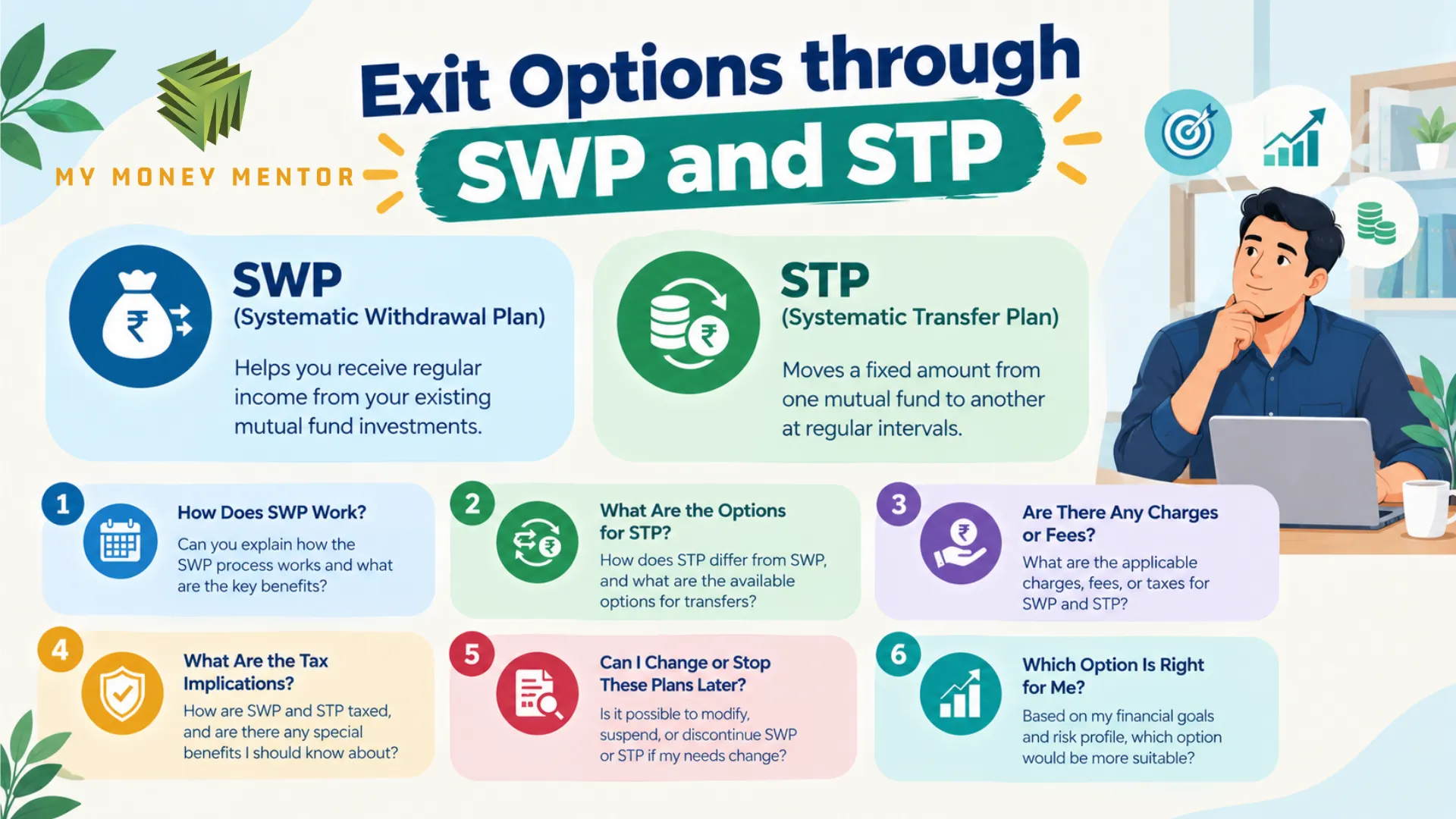
Leaving a mutual fund is not always about withdrawing all the funds at once. If an investor wishes to withdraw his funds gradually or shift his investment from one mutual fund scheme to another, he can use facilities such as the Systematic Withdrawal Plan (SWP) and the Systematic Transfer Plan (STP).
This would make the entire exit process systematic, especially when the investor does not need all the funds immediately.
What is a Systematic Withdrawal Plan?
A Systematic Withdrawal Plan, popularly known as SWP, allows an investor to withdraw funds from their mutual fund investments at fixed intervals. The investor does not have to redeem all the units; he just needs to select an interval, such as monthly or quarterly, based on the scheme’s facilities.
For example, consider an investor who has invested ₹10 lakhs in a mutual fund and requires a fixed monthly amount of ₹25,000 from it. In this case, the investor will be able to make an SWP of ₹25,000 per month, depending upon the facilities provided by the scheme.
SWP could prove beneficial when the investor is looking to withdraw funds at regular intervals rather than the entire amount invested.
But the investor should not have a preconceived notion that the remaining corpus will grow. If withdrawals exceed the gains earned from the investment, the number of units available and their value could decline.
SWP requires proper planning depending on the size of the corpus, the amount of withdrawal needed, and the risk involved. But there is a misconception that the SWP only withdraws the profits from the mutual fund. This is not always true.
In cases where the investor requests ₹20,000 via the SWP, the ₹20,000 worth of units will be redeemed at the prevailing price. The units could comprise the investor’s original investment and any capital gains earned.
For example, let us consider an investor with ₹5 lakh in the market who currently holds ₹6 lakh. A ₹20,000 SWP would not imply that ₹20,000 “profit” will be withdrawn. Rather, the units will be redeemed.
What is a Systematic Transfer Plan?
STP does not include withdrawing money from a mutual fund for individual use. It is the predetermined amount of money or number of units that is merely transferred from one mutual fund scheme to another.
The STP process consists of systematic withdrawal from one scheme and systematic investment into another.
In case an investor holds ₹12 lakh in a relatively low-risk mutual fund and wishes to shift his money into an equity-oriented scheme.
He can instead opt for an assumed monthly STP of ₹1 lakh for 12 months, provided the schemes facilitate such transactions.
The source scheme would liquidate ₹1 lakh worth of units in accordance with the rules, and the equivalent amount would be allocated to the destination scheme.
If the NAV of the destination scheme is ₹100 in a particular month, then ₹1 lakh will purchase 1,000 units.
And if, in another month, the NAV falls to ₹80, ₹1 lakh will buy 1,250 units.
Therefore, the investor will enter the destination scheme at different NAV levels through different instalments. STP does not mitigate the market risks involved or assure profits.
Taxation on Exiting the Mutual Fund
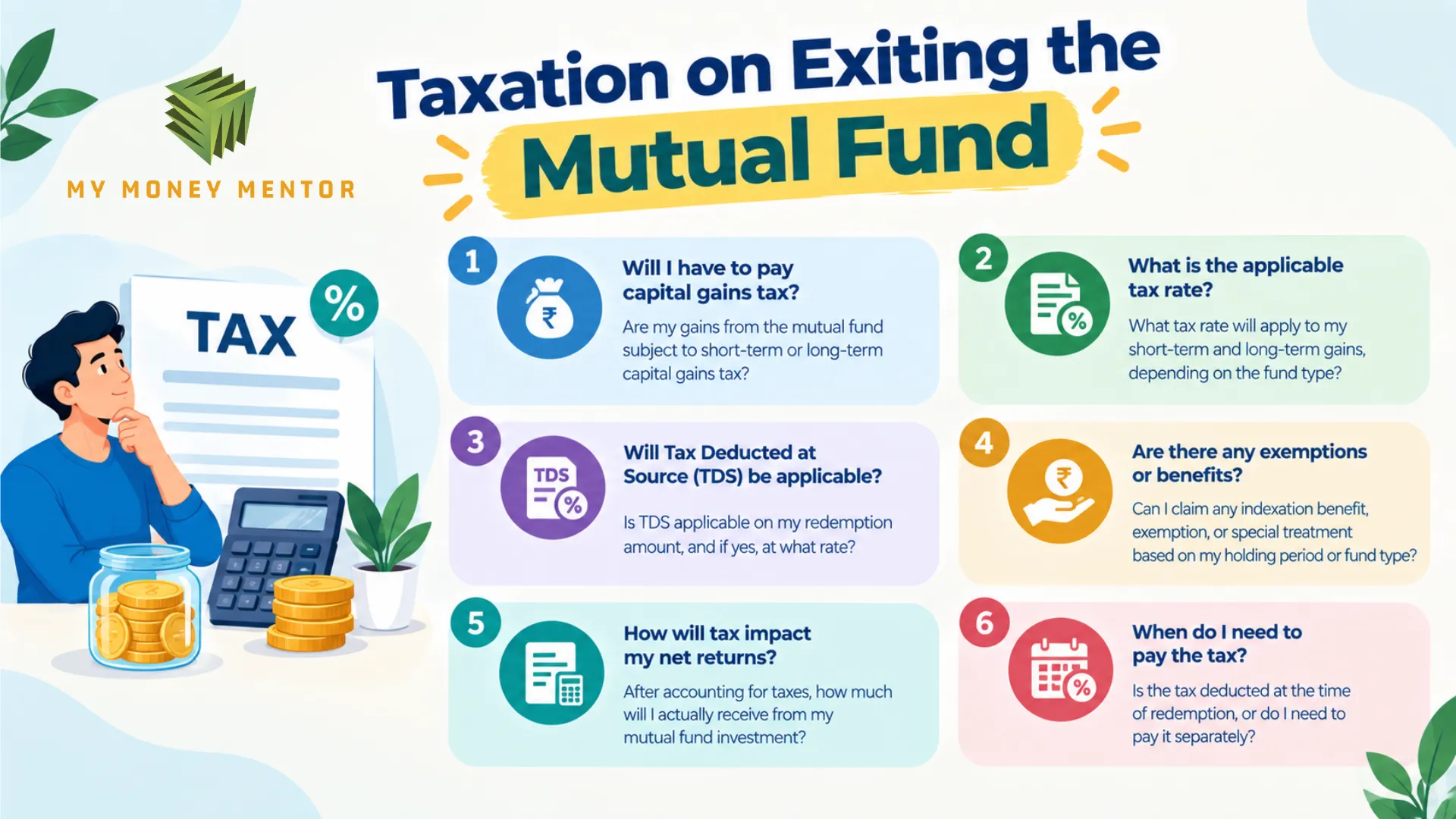
The tax treatment depends mainly on the type of mutual fund, holding period, and applicable tax provisions. The following table provides a simple overview based on current Income Tax Department rules.
Equity Mutual Funds:
| Holding Period | Tax Treatment |
| Up to 12 months | Short-term capital gains taxed at 20% |
| More than 12 months | Long-term capital gains exceeding ₹1.25 lakh in a financial year are taxed at 12.5% |
| LTCG up to ₹1.25 lakh | Exempt, subject to applicable conditions |
Debt and Other Non-Equity Mutual Funds:
Taxes on debt mutual funds and any other non-equity mutual funds would depend on investments. Any mutual fund that makes investments above 65% of total proceeds in debt and money-market instruments or any fund that makes investments of 65% or more in units of these funds falls under the category of specified mutual funds.
The gains from redemption in these specified mutual funds would always be taxed as short-term capital gains, regardless of the period for which the units were held. The gains would be taxed at the normal income tax rate, not the concessional long-term capital gains rate.
Conclusion
Learning how to exit a mutual fund in India should not be decided purely based on the current profit or loss that appears in the portfolio. Instead, one should consider factors like applicable NAV, exit load, holding period, capital gains tax, financial objective, and portfolio allocation.
Investors can minimise their unavoidable losses by considering the exit load period, taxation, maintaining investment documentation, opting for partial redemption, and avoiding avoidable moves driven by market volatility.
The best strategy is to link the decision about the exit to the investment objective. As soon as one reaches their objective or the risk requirements change, they need to think of an exit.
FAQs
Q: What is the cut-off time for mutual fund redemption?
Ans: For most mutual fund schemes, valid redemption requests received by 3 pm on a business day generally receive that day’s closing NAV. Special rules apply to liquid and overnight funds.
Q: What happens to my mutual fund investment if I die?
Ans: The nominee or legal heir can claim the investment by completing the fund house’s transmission process and submitting the required documents. The applicable process depends on the account and scheme requirements.
Q: How long does it take to receive money after redeeming mutual fund units?
Ans: Mutual fund redemption proceeds are generally credited to the investor’s registered bank account within three working days of a valid redemption request. Funds investing at least 80% of their assets in permitted overseas investments may take up to five working days. The actual timeline depends on the scheme and applicable settlement rules.